

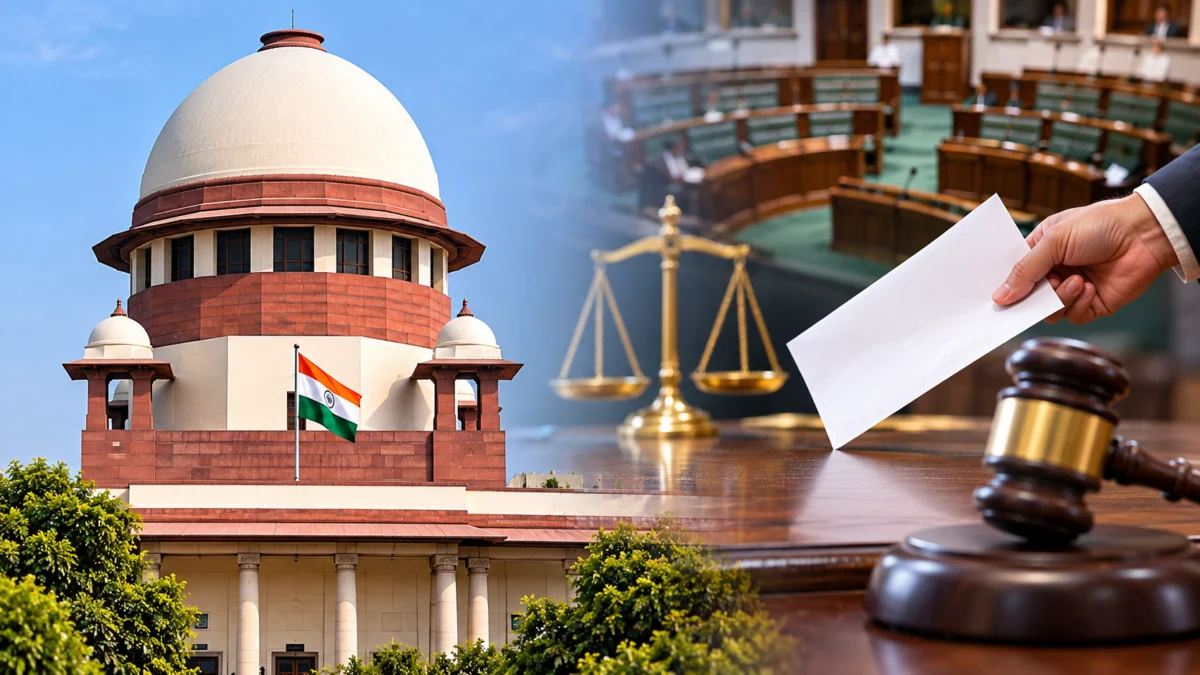
 New Delhi/Nagpur: The Supreme Court has taken serious note of allegations that Members of Legislative Assemblies (MLAs) and Members of Parliament (MPs) are using strategic resignations to evade disqualification proceedings under the anti-defection law. Hearing a Public Interest Litigation (PIL) challenging this practice, the court has issued notices to the Central Government, the Election Commission of India and the Law Commission of India.
The petition argues that elected representatives facing possible disqualification for defection resign from their positions to avoid the consequences of proceedings under the anti-defection law, thereby undermining the very purpose of the legislation.
A bench comprising Chief Justice of India Surya Kant and Justices Joymalya Bagchi and V. Mohan heard the matter. The PIL was filed by A. Sethu, who contended that when legislators resign as soon as disqualification proceedings become imminent, the Speaker or Chairman may be left without an opportunity to deliver a final decision on the pending petitions before the political situation changes.
Petition Seeks to Close Legal Loopholes
The petitioner has argued that strategic resignations are increasingly being used as a means of circumventing the anti-defection provisions. Such a practice, the plea states, weakens the effectiveness of the law intended to prevent elected representatives from switching political allegiance for political gains.
The petition also refers to two important earlier Supreme Court judgments concerning disqualification proceedings.

In Shrimanth Balasaheb Patil v. Speaker, Karnataka Legislative Assembly, the Supreme Court clarified that resignation does not automatically bring an end to disqualification proceedings relating to alleged acts of defection committed before the resignation.
In Keisham Meghachandra Singh v. Speaker, Manipur Legislative Assembly, the court directed that disqualification petitions should ordinarily be decided within three months.
Demand to Restrict Ministerial Appointments
The PIL has also sought restrictions on appointing legislators facing pending disqualification proceedings to positions carrying benefits, including ministerial posts.
It has urged that such representatives should not be appointed to ministerial or other office-of-profit positions until the disqualification proceedings are concluded or they are re-elected.
Another significant demand concerns government formation in hung assemblies. The petitioner has sought a direction that all elected members should complete their oath-taking before a floor test is conducted to establish majority support.
Political Implications of the Case
The Supreme Court’s notice has brought renewed attention to the functioning of the anti-defection law and the use of resignations during political crises.
The court’s eventual consideration of these issues could have implications for the handling of disqualification petitions, government formation and political defections across the country.
The matter is now expected to be closely watched by political parties and constitutional experts, particularly over whether additional safeguards will be introduced to prevent resignations from being used to bypass disqualification proceedings.