

In her 544-page memoir Belonging: A Journey of Love, the Congress leader offers a rare personal assessment of Prime Minister Narendra Modi, questions his political ideology and finds an unexpected point of understanding in their shared discomfort with Delhi’s privileged political establishment.
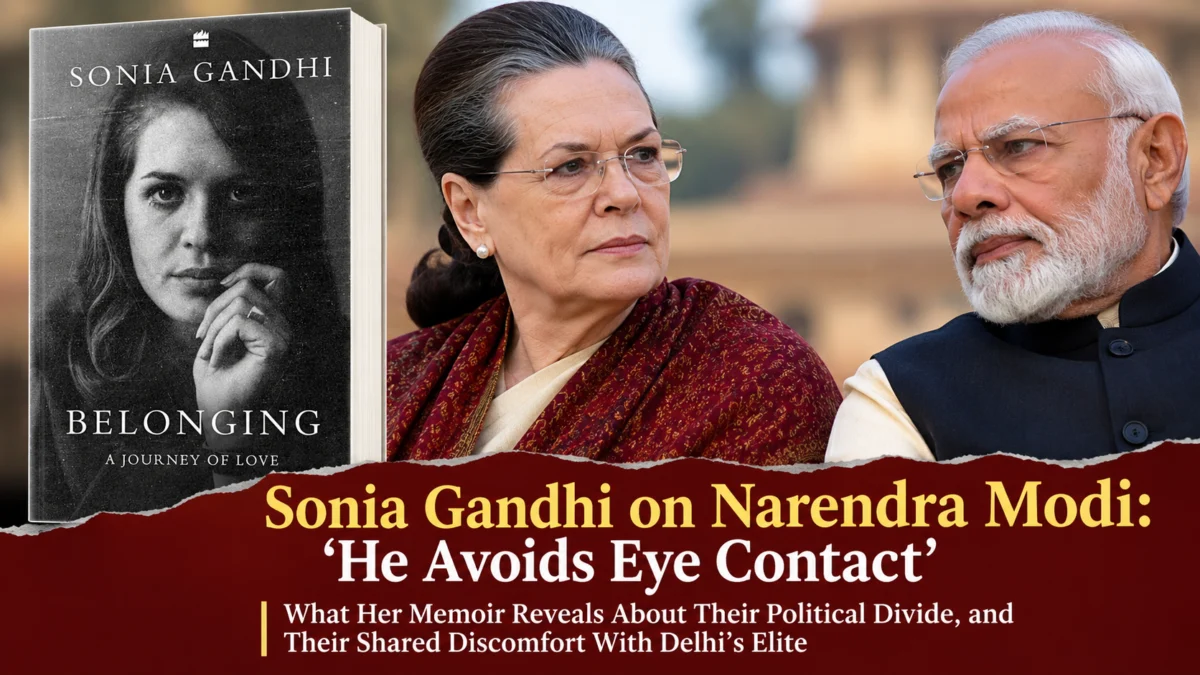 New Delhi: Sonia Gandhi’s newly released memoir, Belonging: A Journey of Love, is more than an account of her personal journey from Italy to the centre of Indian politics. It is also an unusually candid reflection on India’s political establishment, ideological divisions and the personalities who have shaped the country’s political landscape.
Among its most politically significant sections is her assessment of Prime Minister Narendra Modi, her principal political opponent for more than a decade.
Despite their sharply contrasting political beliefs, Sonia makes an interesting observation: she understands some of Modi’s discomfort with Delhi’s privileged political establishment because she has experienced a similar sense of alienation herself.
Her account offers a rare glimpse into how one of India’s most influential opposition leaders views the Prime Minister, his political journey and the competing visions of India that they represent.

Modi and Sonia: Almost No Personal Interaction
One of the most striking revelations in the memoir concerns the limited personal interaction between the two leaders.
Sonia writes that despite Modi having served as Prime Minister for more than 12 years, she has had practically no real contact with him.
Their encounters are largely restricted to semi-official gatherings, particularly meetings in the Speaker’s chamber after Parliament sessions, where leaders of major political parties traditionally assemble.
She recalls that they exchange a formal namaste when they meet. However, she observes that Modi tends to look away and avoid eye contact.
Sonia contrasts this behaviour with an earlier political culture in which leaders across party lines maintained a greater degree of personal cordiality, despite their political disagreements.
She also recalls occasional brief exchanges, including Modi enquiring about her health after she returned from hospital, along with birthday and New Year greetings.
For Sonia, however, these interactions have never developed into a meaningful personal relationship.
Two Different Visions of India
Sonia’s central criticism of Modi is ideological rather than personal.
She traces his political worldview to his upbringing and association with the Rashtriya Swayamsevak Sangh (RSS), arguing that these influences have shaped a fundamentally different understanding of India.
According to her assessment, Modi’s vision places greater emphasis on hierarchy, order and control, while she believes his political ideology gives precedence to his own faith and cultural identity over others.
Sonia contrasts this with her understanding of India as a country built around religious and cultural diversity, individual liberty, equality and the accommodation of different communities.
She writes:
“He was fighting for his vision of India, and I for mine: an India against hegemony, an India that stands for inclusiveness, secularism, and social justice. It wasn’t personal.”
The passage is significant because Sonia explicitly frames the political confrontation between the Congress and BJP as a struggle between two competing ideas of the country, rather than merely a contest between two political personalities.
An Unexpected Similarity: Sonia Also Felt Uncomfortable in Delhi’s Elite Circles
Perhaps the most interesting aspect of Sonia’s assessment is her comparison of her own experiences with Modi’s perceived discomfort around Delhi’s political establishment.
Sonia recalls feeling uncomfortable during conversations in Delhi’s privileged drawing rooms, where discussions often appeared disconnected from the everyday struggles of ordinary Indians.
She writes about encountering people whose understanding of the country seemed far removed from the realities she witnessed during visits to her constituency and journeys across India.
The poverty, hardship and struggle for survival she encountered among ordinary people were often missing from the conversations taking place within these influential social circles.
It is in this context that she says she could understand some of Modi’s unease with the ruling elite.
The observation is particularly interesting given that Sonia herself entered Indian public life through one of the country’s most powerful political families.
Modi, meanwhile, built his political career through the RSS and the BJP, eventually reaching the highest constitutional office in the country.
Their backgrounds and political journeys are vastly different, yet Sonia identifies a shared discomfort with a section of Delhi’s privileged establishment.
However, this perceived similarity does not translate into political agreement. She remains firmly opposed to the ideological direction she believes Modi represents.
Sonia Questions Modi’s Humble Background Narrative
Sonia also makes a pointed observation about Modi’s political journey and the image of his humble origins.
While acknowledging that Modi worked his way to power within the RSS from an underprivileged background, she questions whether his origins were quite as humble as his public relations team has portrayed them.
This is a notable qualification in her assessment.
Rather than dismissing Modi’s rise, she acknowledges his political journey while questioning the narrative constructed around his personal background.
Her comments reflect a broader criticism of how political leaders build and project their public images.
Nehru, Congress and Modi’s Political Attacks
Another major subject in the memoir is Modi’s repeated criticism of former Prime Minister Jawaharlal Nehru.
Sonia argues that Nehru has become a particular target of the BJP’s hostility because of the democratic and secular foundations on which he sought to build independent India.
She is particularly critical of the language Modi sometimes uses against the Opposition in Parliament, arguing that his speeches can resemble the rhetoric of political rallies.
She also takes issue with the BJP’s stated ambition of creating a ‘Congress-free India’.
For Sonia, this is not simply about defeating an opposition party in elections. She views it as an attempt to eliminate the political ideology, policies and historical legacy associated with the Congress.
Her criticism reflects the larger ideological confrontation between the two parties, which has increasingly defined Indian politics over the past decade.
Beyond Modi: A Personal Journey Through India’s Political History
While the Prime Minister occupies an important place in the memoir’s political narrative, Belonging: A Journey of Love covers a much wider period of Sonia Gandhi’s life.
The book traces her childhood in Italy, her years in Cambridge, her first meeting with Rajiv Gandhi in 1965 and their marriage in 1968.
She recalls her relationship with former Prime Minister Indira Gandhi, who became her mother-in-law, and her gradual adjustment to Indian family life and culture.
The memoir also revisits some of the most painful moments in her life, including Indira Gandhi’s assassination in 1984 and Rajiv Gandhi’s assassination in 1991.
Other personal revelations include the loss of her first-born child and her battle with breast cancer.
On the political front, Sonia discusses her eventual entry into Congress leadership, the party’s electoral victories and the formation of the United Progressive Alliance government in 2004.
She explains her decision to decline the Prime Minister’s post and support Manmohan Singh for the position, while also reflecting on her relationships with senior Congress leaders, including Pranab Mukherjee.
These accounts offer an insight into the personal relationships and political calculations behind some of the most consequential decisions in modern Indian politics.
A Political Memoir That Goes Beyond Personal Rivalry
What makes Belonging: A Journey of Love particularly interesting is Sonia Gandhi’s attempt to distinguish political disagreement from personal hostility.
Her assessment of Narendra Modi is strongly critical, particularly on questions of ideology, secularism and the character of Indian democracy.
Yet she acknowledges his political rise and recognises that his discomfort with sections of Delhi’s privileged establishment is something she can understand.
The comparison does not suggest political agreement or personal closeness. Instead, it highlights an unusual point of recognition between two leaders who represent opposing political traditions.
Ultimately, Sonia’s memoir presents her understanding of India as a contest between competing ideas of national identity, governance and social justice.
Whether readers agree with her assessment or not, her observations add a personal dimension to a political rivalry that has shaped India’s national discourse for more than a decade.
Belonging: A Journey of Love, published by HarperCollins India, went on sale across the country on November 10, 2026.