
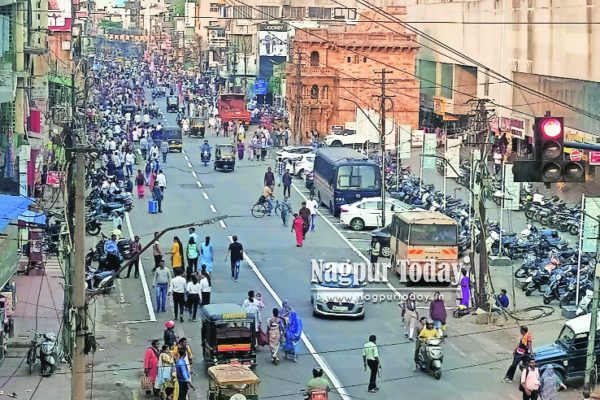
Nagpur: In a city where anti-encroachment drives usually end as temporary spectacles, Sitabuldi Main Road has quietly rewritten the script. The Nagpur Municipal Corporation (NMC), backed by Sitabuldi Police, has managed what many thought impossible, keeping one of the busiest commercial stretches consistently free of illegal hawkers.
The difference is not in occasional crackdowns, but in relentless presence. While most areas witness short-lived drives followed by an almost immediate return of encroachments, Sitabuldi has been placed under continuous watch. The Enforcement Wing has deployed back-to-back teams, ensuring that there is no window for hawkers to reclaim public space.
Gold Rate
May 04- 2026 - Time 10.30Hrs

Superintendent Sanjay Ganesh Kamble describes it as a simple but hard approach, “We don’t give them a chance to come back.” Two shifts operate daily, effectively covering the entire day and evening. The result: footpaths remain usable, traffic flow improves, and pedestrians are not forced onto dangerous roads.
However, beyond Sitabuldi, the ground reality remains grim. Key locations like Jhansi Rani Square, Wardha Road, and IT Park Road continue to be plagued by the same old cycle, action, retreat, and re-encroachment. Even recent drives led by Municipal Commissioner Dr. Vipin Itankar have failed to create lasting impact in these areas. Vendors, well aware of the pattern, simply wait for enforcement teams to leave before setting up shop again.
This decades-old failure has turned into a daily ordeal for citizens. Encroachments not only choke traffic but also push pedestrians into harm’s way. Footpaths, meant for public safety, have effectively become extensions of informal markets.
Recognising the gap, the NMC is now preparing to extend its strategy beyond daylight hours. A dedicated night anti-encroachment drive, likely between 10 pm and 6 am, is on the cards. The aim is clear: eliminate the “after-hours” window that hawkers exploit to reclaim space.
Meanwhile, enforcement actions continue across the city. On Sunday, a major drive was carried out on Sitabuldi Main Road, from Variety Square to Jhansi Rani Square, with full deployment of police and civic teams. Despite being a peak business day, when hawkers typically flood the area due to shop closures, the administration maintained strict control.
The contrast is stark. Where vigilance is constant, encroachments vanish. Where it is not, the problem thrives.
The “Sitabuldi Model” has proven that enforcement works, but only when it is sustained, uncompromising, and immune to routine lapses. The real question now is whether the NMC has the will to replicate this model citywide, or if Sitabuldi will remain just another exception in a city struggling with a problem it has long failed to solve.