

Nagpur: Beneath the façade of life-saving healthcare, a murky network of alleged kickbacks, commonly known as “cut practice, ” is thriving in Nagpur’s medical ecosystem. What should be a system built on trust and ethics is increasingly being accused of operating like an organised commission racket, where patients’ vulnerability becomes a revenue stream.
At its core, “cut practice” refers to an illegal commission arrangement. A doctor refers a patient to a particular private hospital, specialist, pathology lab, radiology unit, or diagnostic centre. In return, the referring doctor allegedly receives a fixed percentage of the patient’s bill, often ranging between 30% and 50%. The commission is quietly built into the inflated charges collected from the patient.
Gold Rate
Mar 12 2026 - Time 11.45Hrs

How the racket allegedly works
Sources describe a structured chain involving three players, the referring doctor, collection centres, and diagnostic laboratories. When a patient is handed a prescription for tests, it often carries a subtle code or marking that signals the diagnostic centre about the referral source. At the end of the month, the agreed commission is reportedly routed back to the doctor.
Patients who attempt to get tests done at another laboratory sometimes find their reports rejected or are pressured to repeat investigations at the “preferred” centre. Many families, already distressed by illness, comply without question.
Insiders allege that in several cases, unnecessary tests are prescribed purely to maximise billing and commission returns.
The price gap: A silent burden
Data gathered from industry sources suggests a stark difference between standard walk-in rates and rates charged to referred patients:
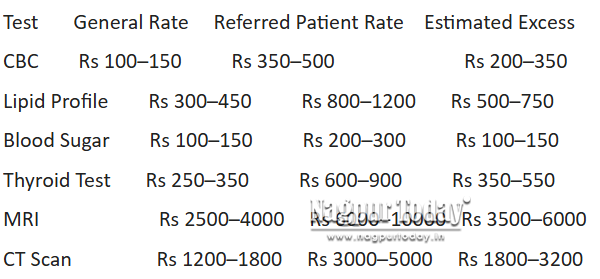
The disparity points to potential overcharging that can double, or even triple, the cost of diagnostics.
A growing Industry
Nagpur has more than 150 small and large pathology labs and diagnostic centres. On average, a single lab handles around 25 patients daily, a number that surges beyond 100 during dengue and malaria seasons. Even a modest commission percentage across such volumes translates into significant monthly payouts.
Healthcare insiders say the system has evolved into an informal but deeply entrenched marketplace, one that operates in the shadows but affects thousands of patients.
Patient rights and regulatory gaps
Legally and ethically, a patient has the right to choose any certified laboratory for diagnostic tests. A doctor cannot compel a patient to visit a specific centre. However, awareness remains low, and enforcement weak.
Experts argue that mandatory public display of standardised government-approved rates, stricter audits, and transparent billing norms are urgently needed. Without price regulation and accountability mechanisms, they warn, exploitation will persist.
Ethical questions
Medical professionals are bound by ethical codes that prohibit fee-splitting and commission-based referrals. Yet, enforcement remains sporadic. Critics say the absence of consistent monitoring has allowed “cut practice” to morph from isolated misconduct into what resembles an organised parallel economy within healthcare.
For patients battling illness, the choice is often between financial strain and blind trust. In that imbalance lies the real cost of the alleged commission culture, one that not only drains wallets but also erodes faith in the healthcare system.