

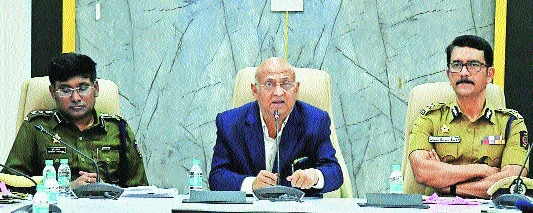
Nagpur: With road accidents continuing to claim thousands of lives across the country, former Supreme Court judge and Chairman of the Supreme Court Road Safety Committee Abhay Sapre has called for uncompromising enforcement of traffic regulations in Nagpur district, including consideration of a stringent ‘No Helmet, No Fuel’ policy.
At a road safety review meeting held at Niyojan Bhavan, Sadar, Sapre directed officials to intensify enforcement, strengthen public awareness and ensure coordinated action by government departments, industrial establishments and educational institutions to bring down accidents and fatalities. He sought action-taken reports on the measures by December, setting the administration a clear deadline to demonstrate progress.
Five lakh accidents, two lakh deaths annually
Highlighting the alarming national road safety scenario, Sapre pointed out that India witnesses nearly five lakh road accidents and around two lakh deaths every year. He stressed that Nagpur must work towards the ambitious objective of zero road accidents through sustained enforcement and collective responsibility.

He called upon government departments, industries and educational institutions to make helmet and seatbelt compliance mandatory for entry into their premises. People violating traffic safety norms should face strict action, while awareness campaigns must be intensified to drive home the importance of responsible road behaviour.
The Education, Transport and other concerned departments were directed to coordinate their efforts instead of treating road safety as the responsibility of traffic police alone.
Rural roads emerge as major accident hotspots
The review revealed that Maharashtra has nine districts, including Nagpur, among the country’s 100 accident-prone districts. Rural areas continue to record more accidents than urban locations, raising concerns over road infrastructure, traffic management and enforcement outside city limits.
Narrow roads, heavy movement of vehicles, reckless driving and inadequate streetlighting were identified as major factors contributing to accidents. Sapre stressed the need to address these deficiencies alongside strict action against traffic violators.
Emergency response, CCTV surveillance under focus
Sapre also emphasised the importance of immediate medical assistance to accident victims, directing authorities to ensure that injured persons are shifted without delay to the nearest hospital. Timely treatment, he said, could prove decisive in saving lives.
Officials informed the meeting that Nagpur city has approximately 3,000 CCTV cameras and that road safety awareness initiatives and other interventions had contributed to a reduction in accidents and fatalities.
Police Commissioner Vishwas Nangre Patil, Superintendent of Police Dr Harssh Poddar, Deputy Commissioner of Police (Traffic) Aditya Mirkhelkar and Nagpur Municipal Corporation Chief Engineer Leena Upadhye attended the meeting.