

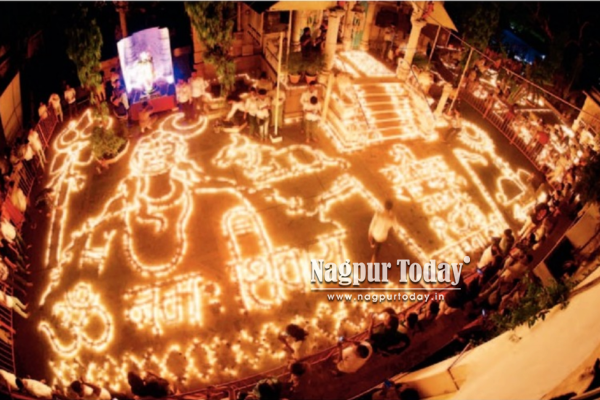
 Nagpur: The sacred flame of devotion burned bright as 1.50 lakh diyas illuminated the night sky on the 103rd foundation day of Shri Poddareshwar Ram Mandir, the historic temple of Nagpur that has stood as a beacon of faith on Central Avenue since 1923. The rhythmic beats of Shivmudra Dhol Tasha reverberated through the air, adding to the grandeur of the occasion.
A Grade-II heritage structure, this temple is more than just a place of worship; it is a silent witness to Nagpur’s transformation — from the capital of the Central Provinces to one of India’s top ten cities. Towering in front of it, the twin cable-stayed Ram Jhula bridges, named after the temple’s presiding deity, Lord Ram, symbolize the seamless connection between the city’s past and present.
A legacy rooted in faith and prosperity
Gold Rate
June 09 2026 - Time 10.30Hrs

The temple, built by the illustrious Poddar family, has become a spiritual cornerstone for generations of Nagpurians. The saga of its construction traces back to Jamnadhar Poddar, a visionary entrepreneur who arrived in Nagpur from Rajasthan in the 1800s. His association with Jamsetji Tata’s Empress Mills was instrumental in shaping his legacy. Recognized for his dedication, Poddar was appointed the sole agent to market Empress Mills’ cloth across undivided India—a venture that brought him immense wealth.
With a heart set on giving back to the city, Poddar acquired land in 1919 to erect the magnificent Ram temple. The structure, designed in an octagonal style, mirrors traditional Indian temple architecture and finds a parallel in the Ayodhya Ram Mandir. The temple enshrines not just Ram, Sita, and Laxman but also Hanuman, Garuda, Sugreeva, Ganga, Mahalaxmi, Laxmi-Narayan, and a revered Shiva shrine.
Standing tall through time
While Empress Mills has faded into the annals of history, Shri Poddareshwar Ram Mandir remains an unshakable symbol of devotion, culture, and resilience. From political upheavals to civic progress, the temple has witnessed it all, its sanctum resonating with unwavering faith.
As Nagpur marches toward the future, this temple remains its soul — a luminous testament to heritage, spirituality, and the undying spirit of Lord Ram.


नाबालिग छात्रा से किया दुष्कर्म .. #nagpurnews #crime #newsupdate

कार का शीशा तोड़ 5 लाख चोरी; दिनदहाड़े बॅगलिफ्टिंग.. #nagpurnews #latestnews #crime

GANGA-JAMUNA इलाके में युवक से चाकू की नोक पर 25 हजार की...

मोमिनपुरा में पुराने विवाद पर युवक पर जानलेवा हमला.. #nagpurnews #Crime #LatestNews

शादी नहीं होने के तनाव में युवक ने दी जान.. #nagpurnews #LatestNews...

विकास ठाकरे का 5 करोड़ मानहानि दावा; मार्मिक के लेख पर ठाकरे...