

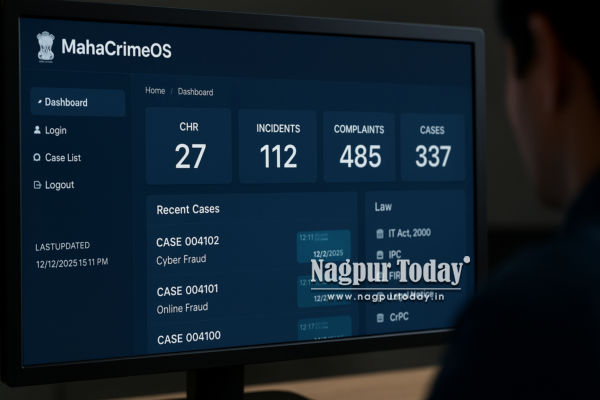
Nagpur: Maharashtra’s experiment with artificial intelligence in policing has taken shape in Nagpur, where the MahaCrimeOS platform, an AI-powered investigation system, has been quietly transforming the way cybercrime cases are handled since April. What began as an initiative of the Nagpur Rural Police has now become the blueprint for the entire State. On December 12, the Maharashtra Government and Microsoft announced that the system, currently operational across 23 police stations in Nagpur district, will be extended to all 1,100 police stations statewide.
Chief Minister Devendra Fadnavis described the expansion as a milestone in citizen-focused governance. “Ethical and responsible AI for public good is our core motto,” he said, emphasising that AI-driven systems will enhance efficiency and improve the quality of life. MahaCrimeOS, developed by CyberEye using Microsoft Foundry technology and deployed under MARVEL (Maharashtra Advanced Research and Vigilance for Enforcement of Reformed Laws), works as an AI “copilot” for investigators, automating frontline tasks from data collection to actionable leads.
Gold Rate
Mar 30,2026 - Time 10.26Hrs

Nagpur’s results lead the State push
Speaking to reporters, State Cyber Cell DIG Sanjay Shintre said Nagpur’s results were the key reason behind the state-wide rollout. “The project, initiated by the Nagpur Rural SP, has been extremely helpful in crime data collection and in generating solid leads,” he said. The platform’s relevance has grown amid an alarming rise in digital frauds, investment scams, refund frauds and online trading rackets being the most common.
Central Government data highlighted the scale: 2.27 million cybercrime cases recorded nationwide in 2024, with losses exceeding Rs 22,800 crore. One such case emerged from Nagpur district itself.
Nagpur victim’s case shows AI’s impact
Nitu Y, a bank clerk from Saoner, invested in an online trading app for a month and saw what appeared to be profits of Rs 90 lakh. When she tried to withdraw her money, she was manipulated into paying hefty “commission” charges through RTGS transfers. “They told me RTGS is not instant… that’s when I realised it was fraud,” she recalled.
She dialled 1930, India’s national cybercrime helpline, and filed an FIR at Saoner Police Station. The entire process took only 15 minutes. The difference came when MahaCrimeOS AI took over: officers uploaded screenshots, URLs, bank statements, WhatsApp chats, and social media links, whether typed, scanned, or handwritten in English, Hindi or Marathi. The AI automatically categorised and filed this data within minutes.
Assistant Police Inspector Ashish Singh Thakur, who led the investigation, said the same process would earlier take two to three months. “We had to visit banks, draft dozens of letters, track IPs and phone numbers. With the AI, the work was finished in about a week,” he said. He now handles seven to eight cases a month, compared with a single case earlier.
MahaCrimeOS automates tasks such as drafting letters, requesting call detail records, and linking digital evidence. It also has built-in references to criminal laws and OSINT (open-source intelligence) tools, helping officers connect cases and identify suspects faster.
CyberEye founder and CEO Ram Ganesh said the biggest hurdle was the lack of standardisation across police reports, formats and notices. “We worked closely with MARVEL to embed Maharashtra police protocols and provide the platform in Marathi,” he said.
Nagpur Rural SP and MARVEL CEO Harssh A. Poddar said the platform tailors investigation plans automatically based on best practices. Officers can now track actions such as freezing bank accounts, blocking phone numbers or taking down fraudulent social media profiles. “The digital companion builds professional capability, boosts confidence and strengthens decision-making,” he said.
Nagpur officers say their workload has transformed
Assistant Investigator Sangita Gawande of Nagpur Rural, with seven years of cybercrime experience, said she now handles nearly 200 cases a month, a massive jump from the two or three cases she managed earlier. “Now I can finish reports quickly and respond faster to victims and seniors,” she said.
The initiative complements federal measures such as the 1930 cyber helpline, the National Cybercrime Reporting Portal and state cyber cells under I4C. Fadnavis said the collaboration with Microsoft began with cybercrime but will expand. “AI touches every sphere, from healthcare to agriculture and governance. We want to harness it responsibly to build a citizen-centric state.”
Nitu, who lost over Rs 30 lakh between March and April, has recovered about Rs 8 lakh so far through frozen accounts traced across India. Though the financial hit remains heavy, she emphasises the importance of timely policing. “The money may or may not come back, but the support from the police will always stay,” she said.