

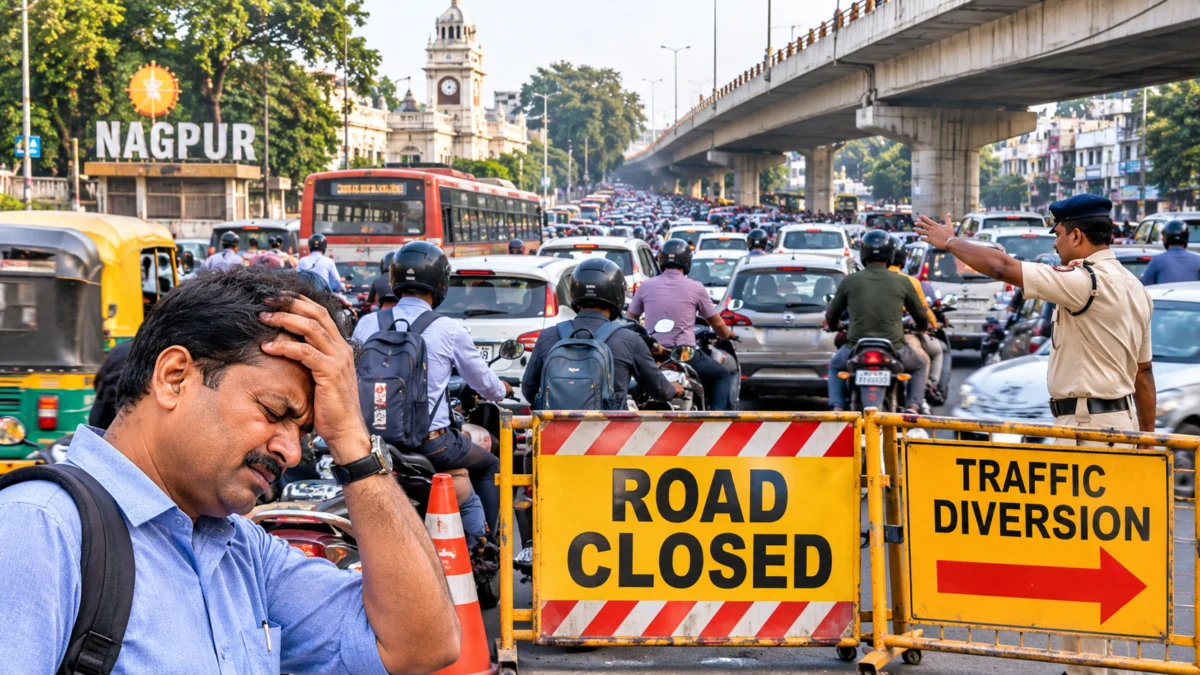
Nagpur: What was supposed to be a traffic management exercise turned into a nightmare for thousands of motorists on Monday evening, as Nagpur’s traffic police appeared completely overwhelmed by their own diversion plan. The simultaneous closure of Sitabuldi Flyover and four crucial road stretches brought the city’s nerve centre to a grinding halt, leaving commuters stranded for hours in an unprecedented traffic mess.
With vehicles crawling at a snail’s pace, roads turning into virtual parking lots and incessant honking filling the air, the much-publicised traffic arrangements for Shaheed Gowari Smruti Din exposed glaring gaps in planning, coordination and enforcement. Motorists questioned how the traffic police could shut down several key arterial roads without ensuring adequate deployment of personnel or making proper arrangements to handle the inevitable diversion of traffic.
The cascading congestion spread far beyond the restricted stretches, paralysing roads across an approximately four-kilometre radius. Worse, traffic personnel were reportedly conspicuous by their absence at several crucial bottlenecks, leaving motorists to fend for themselves amid mounting chaos. Double parking on already congested roads further choked the available carriageway, turning an already difficult situation into a prolonged ordeal.
Apart from Sitabuldi Flyover, traffic was prohibited on the stretches between Samvidhan Square and Morris Square, Manas Square and Morris Square, Jhansi Rani Square and Morris Square, and Kannamwar Square and Zero Mile. The simultaneous restrictions disrupted the movement of vehicles across multiple directions, with the impact spilling over onto adjoining roads.

Akashwani Square-Maharajbagh, Samvidhan Square-Railway Station and Samvidhan Square towards Lok Bhavan and Sadar emerged among the worst-affected stretches. The traffic nightmare engulfed VIP Road, Ramdaspeth, Dhantoli, Sadar, Cotton Market, West High Court Road, East High Court Road and several internal roads.
Wardha Road beneath Sitabuldi Flyover remained particularly chaotic throughout the day. Motorists travelling towards the western parts of the city were advised to take West High Court Road, while those heading east were directed through Congress Nagar-Dhantoli Road. But these alternative corridors, instead of easing the pressure, became additional choke points as vehicles poured in from multiple directions.
Motorists alleged that the traffic police failed to anticipate this spillover effect. The absence of effective regulation at junctions and the unchecked double parking only aggravated the situation. The result was a chain reaction in which one traffic bottleneck triggered another, leaving commuters with virtually no escape route.
The consequences were not merely about inconvenience. Several commuters suffered tangible losses, including missed trains and disrupted schedules.
A Wardha resident working in Nagpur recounted how the traffic chaos cost him his journey home. He was at the Nagpur Municipal Corporation headquarters and had to reach Ajni Railway Station to catch a 5 pm train to Wardha. Leaving around 4.15 pm, he expected to cover the distance in barely 10 minutes.
However, with the usual route clogged, he was forced to take a longer detour via Aath Rasta Square. Despite leaving well in advance, he reached the station nearly 30 minutes late and missed his train.
The commuter’s ordeal reflected the plight of countless others who found themselves trapped in a traffic management exercise that seemingly failed its most basic objective, keeping the city moving.
The episode raises uncomfortable questions about the wisdom of shutting multiple major roads simultaneously without adequate contingency arrangements. If designated diversion routes cannot absorb the diverted traffic, and traffic personnel are not visible at critical junctions, what purpose does an elaborate diversion plan serve?
Shaheed Gowari Smruti Din may have necessitated traffic restrictions, but it certainly did not warrant leaving thousands of citizens at the mercy of a chaotic road network. Traffic management is not simply about putting up barricades and prohibiting movement; it demands advance planning, coordinated deployment, strict enforcement and real-time intervention.
On Monday, Nagpur’s motorists were left wondering whether any of these essentials had been adequately considered.