

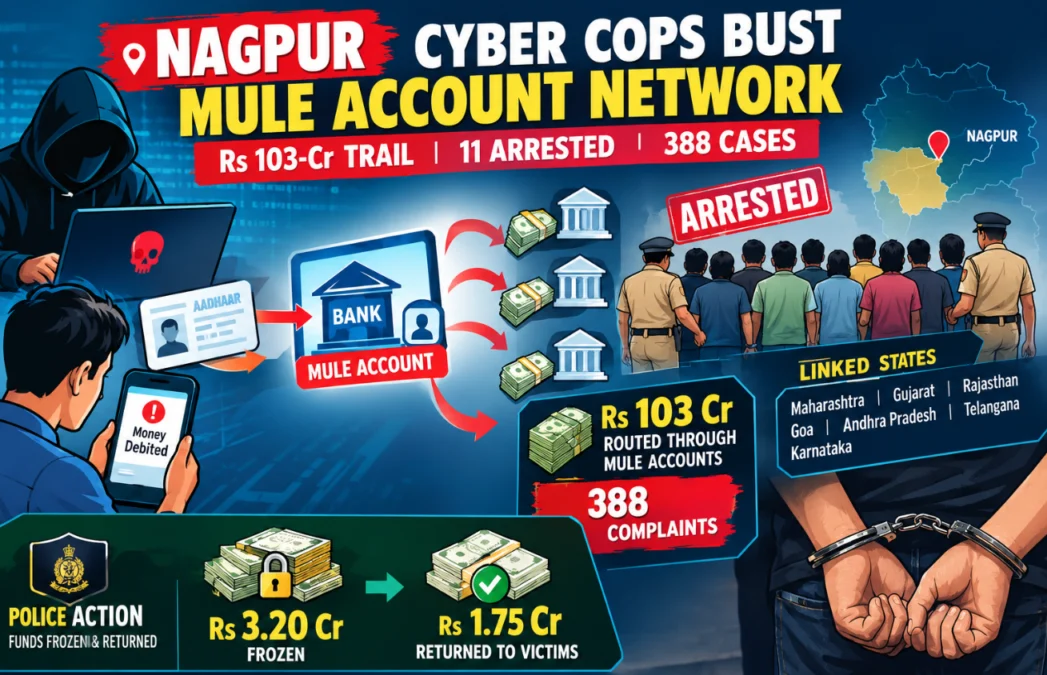
Nagpur: Unsuspecting citizens are increasingly finding themselves at the centre of cybercrime investigations after their identity documents are allegedly misused to open bank accounts that criminals exploit to move money stolen from fraud victims. An investigation by Nagpur cyber police has uncovered the scale of this network, with Rs 103 crore routed through suspected mule accounts in cyber fraud cases linked to the city.
Police have arrested 11 persons from different States in connection with 388 complaints, exposing an alleged network that used bank accounts opened with misused identity documents to receive and transfer proceeds of cyber fraud. The findings point to a financial trail extending beyond Maharashtra, with complaints linked to Gujarat, Rajasthan, Goa, Andhra Pradesh, Telangana and Karnataka.
The case highlights a critical vulnerability in the cybercrime ecosystem: fraudsters do not always need to operate bank accounts in their own names. By allegedly exploiting the identities of unsuspecting citizens, they can create additional layers between themselves and the stolen money, complicating efforts to identify the beneficiaries and recover funds.
Mule accounts become a crucial link in cyber fraud

Mule accounts are bank accounts used to receive, hold or transfer money obtained through illegal activities. In cyber fraud cases, such accounts often serve as intermediaries between the victim’s account and the people controlling the criminal operation.
According to the findings of the Nagpur cyber police investigation, identity documents belonging to unsuspecting individuals were allegedly used to open accounts without their knowledge. The accounts were subsequently used to receive money cheated from victims and transfer it to other accounts, making it harder for investigators to establish the complete money trail.
The practice creates multiple layers of transactions. Once the money enters an account, it may be transferred to other accounts, potentially across different banks and States. This movement can complicate the process of tracing the original beneficiary, identifying the people controlling the accounts and freezing the funds before they are withdrawn or moved further.
For the people whose documents are allegedly misused, the consequences can extend beyond identity theft. Their names and banking details may emerge during police investigations, potentially exposing them to inquiries into transactions they claim to know nothing about.
Rs 103 crore trail spans several States
Investigations conducted over the past two years have revealed links to complaints from Maharashtra, Gujarat, Rajasthan, Goa, Andhra Pradesh, Telangana and Karnataka. Police have arrested 11 persons from different States in connection with the 388 complaints.
Investigators suspect that the accused worked in coordination to receive money generated through cyber frauds and route it through multiple bank accounts. The use of accounts associated with different identities allegedly helped move the money away from its original destination and made the trail more difficult to follow.
The Rs 103-crore figure represents the volume of money routed through the suspected accounts in cases linked to the investigation. It should not automatically be interpreted as the amount recovered, the total loss suffered by individual complainants or money attributable in full to each of the arrested persons.
Establishing the role of individual account holders, identifying those who allegedly arranged the accounts and tracing the final recipients of the funds remain important elements in investigating such networks.
The geographical spread of the complaints also underscores the challenges faced by cyber police. Transactions can cross State boundaries within a short period, requiring investigators to coordinate financial records, account details and evidence from multiple jurisdictions.
Identity theft creates a hidden financial pipeline
The alleged misuse of citizens’ documents raises questions about how bank accounts were opened, who supplied the documents and who exercised control over the accounts once they became operational.
A key investigative task is to establish whether the individuals named in account records knowingly participated in the transactions or whether their identities were used without their consent. The distinction is significant because the account holder on paper may not necessarily be the person directing the movement of money.
Investigators also need to establish how the accounts were recruited into the alleged network, who controlled the banking credentials and where the funds went after being transferred from the initial receiving accounts.
The answers could help police identify the wider network behind the transactions rather than limiting the investigation to the accounts through which the money passed.
The case serves as a warning to citizens to exercise caution when sharing identity documents, bank details or access to financial accounts. People should not allow others to use their accounts to receive or transfer money on their behalf without a legitimate and verified reason. Anyone who suspects that their documents have been misused should promptly notify the bank and report the matter to the police.
Rs 3.20 crore frozen; Rs 1.75 crore returned to victims
Alongside its investigation into the alleged mule-account network, Nagpur Police have taken steps to prevent the dissipation of money reported lost to cyber fraud and facilitate its return to victims.
This year, police have frozen Rs 3.20 crore linked to fraudulent transactions in various bank accounts. Of this amount, Rs 1.75 crore has already been returned to victims, according to information provided by the police.
The remaining amount is expected to be returned to the complainants after completion of the prescribed legal procedures.
Freezing suspicious funds at an early stage can be crucial in cyber fraud cases. Money transferred through several accounts may be withdrawn or moved further before investigators can identify the trail. Prompt intervention can preserve at least part of the amount for potential restitution, although freezing funds does not by itself guarantee that every victim will recover the full loss.
The amount returned to victims demonstrates the importance of reporting fraud quickly and initiating action through banks and law enforcement agencies while the money remains traceable.
Recovery and accountability remain the key challenges
The investigation brings two interconnected challenges into focus: dismantling the networks that allegedly arrange and operate mule accounts, and ensuring that victims recover money before it disappears through successive transactions.
The arrest of 11 persons and the examination of 388 complaints mark significant investigative steps. However, the full extent of the alleged network will depend on the identification of those who arranged the accounts, the people who ultimately received the money and the role played by individual account holders.
The Rs 103-crore transaction trail also highlights the need for vigilance against the misuse of personal documents and for swift coordination between banks and police when suspicious transfers are reported.
For victims, the immediate priority is the recovery of their hard-earned money. For investigators, the larger task is to establish how the accounts were opened and controlled, follow the money beyond the first layer of transfers and hold the responsible individuals accountable.
The Nagpur investigation illustrates how cyber fraud can extend well beyond a fraudulent phone call, message or online transaction. Behind the apparent digital deception may lie a network of bank accounts and financial transfers designed to distance the perpetrators from the stolen money — and to make recovery increasingly difficult.