

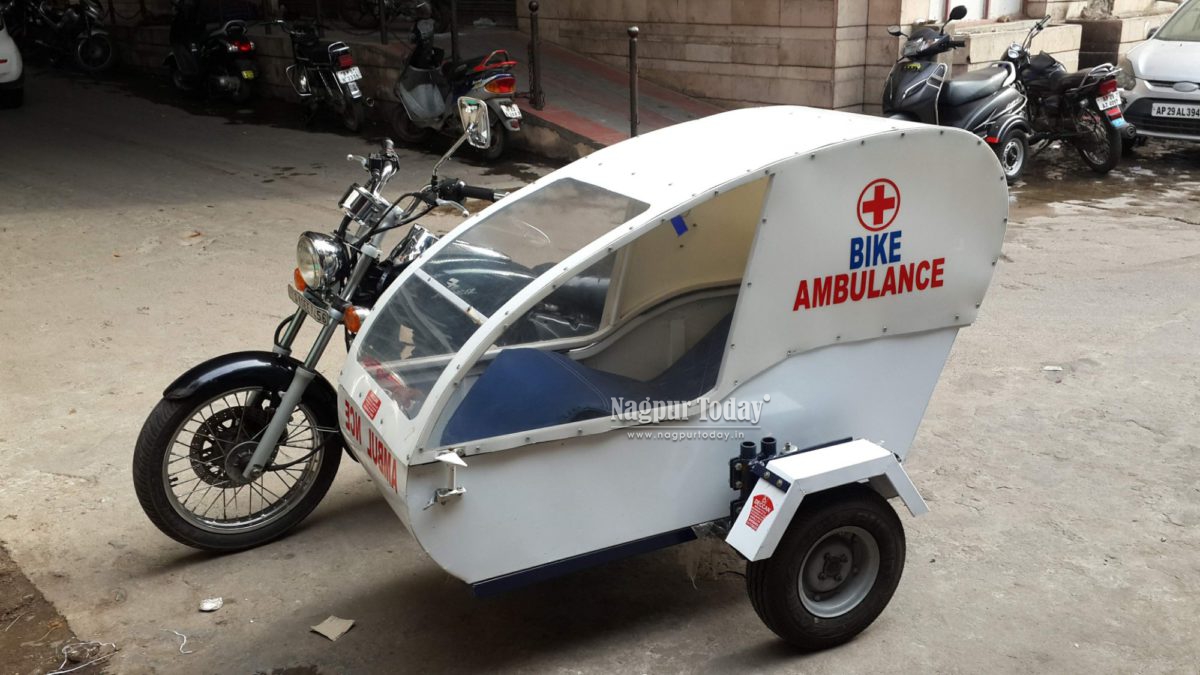
Nagpur: What was once projected as a game-changing innovation in emergency healthcare has now crumbled into a stark example of policy failure. Maharashtra’s much-publicised bike ambulance service, launched with the promise of reaching the unreached, has ground to a halt, leaving remote and tribal populations stranded without timely medical aid.
Introduced in 2017 with considerable fanfare, the initiative aimed to bridge the critical gap in emergency response across inaccessible regions of Maharashtra. The concept was simple yet powerful: deploy two-wheeler ambulances capable of navigating narrow, rugged terrains where conventional ambulances cannot reach. Initially funded through CSR initiatives, the project began modestly with 10 units and later expanded to 30 across the State.
Gold Rate
June 30,2026 - Time 10.30Hrs

However, the grand vision never translated into sustained action. Plans to scale the fleet to over 300 units remained confined to official files. Today, the existing bike ambulances lie idle, reduced to mere backup units with no active deployment, exposing the fragile foundation on which the scheme was built.
The service was particularly crucial for underserved pockets such as Melghat and Gadchiroli, including Naxal-affected zones where healthcare access is already a daily struggle. In these regions, every minute can mean the difference between life and death. Yet, as funding from the Central Government dried up by 2024, the initiative collapsed, bringing emergency response in these areas back to square one.

Equipped with patient trolleys, oxygen cylinders, first-aid kits, and communication devices, these bikes were designed for the harshest terrains, from forest interiors to hilly tribal belts like Bairagad, Harisal, and Tembhusonda. Their sudden disappearance from active service has left a vacuum that no alternative system has been able to fill.
The fallout extends beyond infrastructure. With the scheme’s collapse, trained emergency medical technicians (EMTs) who once operated these units have been displaced, further weakening an already overstretched rural healthcare system.
Health experts are scathing in their assessment. Many point out that the government’s over-reliance on CSR funding and contractual arrangements, without committing its own financial resources, made the scheme inherently unstable. “Innovative ideas cannot survive on temporary funding. Without long-term commitment, such projects are bound to fail,” remarked a senior public health expert.
In a move that has sparked more skepticism than optimism, authorities have floated a fresh tender claiming that 196 ambulances, including 166 new bike units, will be deployed. But given the track record, many fear this may be yet another announcement that fails to materialise on the ground.
The collapse of the bike ambulance service is not just an administrative lapse, it is a serious indictment of the State’s approach to rural healthcare. It underscores a harsh reality: without sustained investment, accountability, and political will, even the most promising solutions can disintegrate, leaving the most vulnerable to fend for themselves.
For thousands living in Maharashtra’s remote corners, what was once hailed as a lifeline has now become a symbol of neglect, another broken promise in the long struggle for accessible healthcare.


NMC Commissioner Pulls Up Officials Over Waterlogging

सोलर प्लांट के बावजूद भारी बिजली बिल #maharashtranews #smartmeter #electricity #bills #newsupdate

ट्यूशन फीस बढ़ोतरी के खिलाफ कांग्रेस आंदोलन #maharashtranews #tuitionfees #congress #andolan

महिला को एमडी ड्रग्स के झूठे केस में फंसाने की साजिश नाकाम...

एमआईडीसी में युवक की बेरहमी से हत्या #nagpurnews #crime #murdernews #newsupdate

सिर्फ एक धक्का... फिर चला चाकू #nagpurnews #crime #accusedarrested #murdernews