

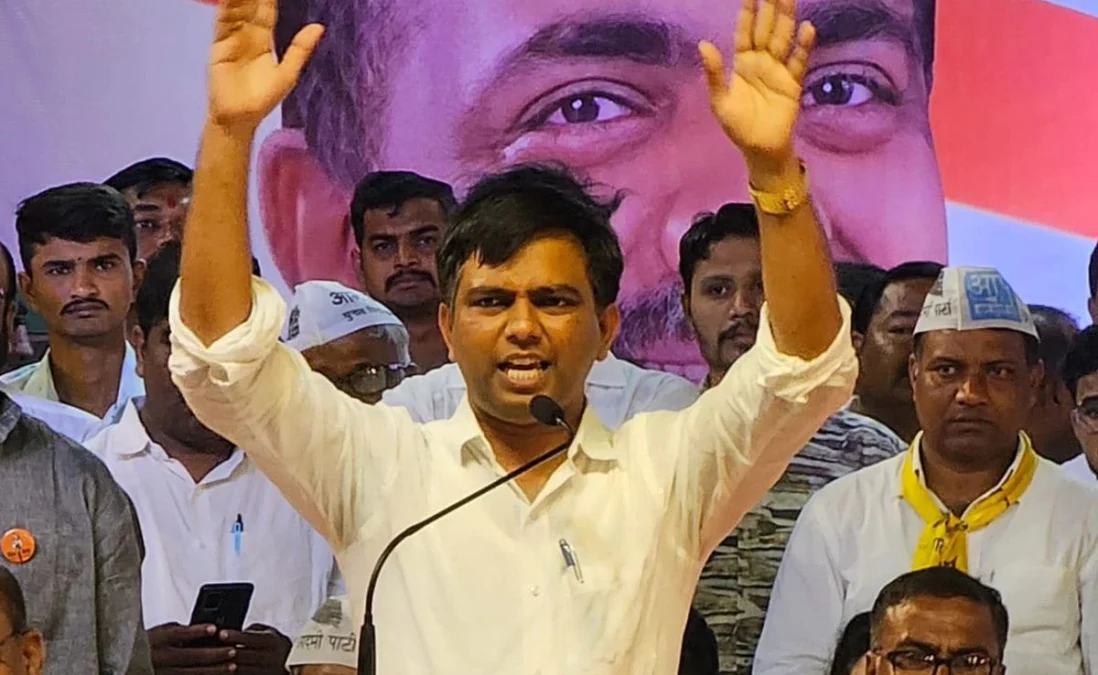
Nagpur: He was denied a party ticket, expelled for refusing to withdraw from the contest and written off by political heavyweights. Yet, in a stunning twist, independent candidate Nitesh Karale emerged as the most talked-about player in the Nagpur Division Graduates’ Constituency election, turning a direct BJP-Congress battle into a nail-biting political thriller.
The Wardha-based social media influencer-turned-politician, who entered the fray after being denied a ticket by the Sharad Pawar-led NCP (SP), dramatically altered the electoral arithmetic by securing more than 25,000 first-preference votes. With neither BJP candidate Sudhakar Kohale nor Congress nominee Abhijit Wanjari initially managing to reach the winning quota of 75,438 votes, Karale’s ballot share became the centre of attention, making his second-preference votes potentially decisive.
The contest, which began with the BJP and Congress locked in a direct fight, soon turned into a prolonged battle of numbers, patience and political calculations. As counting progressed through successive rounds, the lead between Kohale and Wanjari fluctuated, keeping both camps on tenterhooks. Even after nearly 40 hours of counting, the suspense remained intense, with the preferential voting system adding another layer of complexity to the outcome.
Karale’s entry into the contest had initially appeared to be a challenge to his own political establishment. The NCP (SP) had denied him a ticket after the seat was allotted to the Congress under the alliance arrangement. However, Karale refused to withdraw his nomination and was subsequently expelled from the party for six years.

What followed was an unexpected show of independent political strength. Without the organisational machinery of either national party, Karale managed to attract a substantial number of first-preference votes, forcing both Kohale and Wanjari to reckon with a candidate who was never expected to dictate the course of the contest.
In a video message posted on social media, Karale asserted that his support had been built through direct public engagement rather than conventional electioneering.
“I built this support of people without the backing of any established party. I did not distribute cash, nor did I organise liquor or meat parties. I did not even put up banners during the campaign. This is happening because people believed in me,” he said.
Karale also alleged that nearly 8,000 ballots cast in his favour had been rejected because some voters wrote “21” against his name or marked their ballots incorrectly. The claim, if substantiated, would further underline the significance of his support base, though the allegation would require independent verification.
He attributed his electoral performance to his involvement in protests and public interventions, claiming that his politics centred on raising people’s issues on the ground rather than relying solely on speeches and publicity.
The winning quota of 75,438 votes proved to be a formidable hurdle for both leading candidates in the initial stages of counting. Under the preferential voting system, the elimination of candidates and the transfer of valid second-preference votes can reshape the standings, making every ballot potentially consequential.
As a result, Karale’s votes assumed significance far beyond his own prospects of winning. Both the BJP and Congress were compelled to watch the transfer of preferences closely, hoping that the next stages of counting would tilt the balance in their favour.
In a contest dominated by two major political parties, the candidate denied a ticket by his own party had unexpectedly become the kingmaker. Karale’s performance demonstrated how an independent candidate, even without the backing of a major political organisation, can disrupt established electoral calculations and turn a seemingly predictable contest into a gripping political drama.
Wanjari eventually emerged victorious, but Karale’s strong showing remained one of the defining features of the election. His rise from a denied aspirant to a decisive factor in the counting process offered a striking reminder that electoral influence is not always determined by party banners, organisational muscle or conventional campaign resources.