



 Here’s something most PR guides skip: journalists almost never rewrite your boilerplate. They copy it.
It makes sense when you think about it. They’re on deadline, they need a sentence explaining who you are, and you’ve handed them one. If that sentence is vague or stuffed with buzzwords, it either gets cut or, worse, it runs exactly as written.
So if you’re working out how to write a company boilerplate that holds up in print, start by writing it for the person who’ll be copying it.
To see how other companies approach this, compare your draft with these company boilerplate examples from real press releases.
How Journalists Really Use Your Boilerplate
There are three kinds of reporter reliance on the boilerplate in practice.

The first one is fact checking. Your release’s dateline at the top indicates where and when your news occurred. The boilerplate will convey to them that you are a certain person. The first place to look for a story before it runs is the boilerplate which includes your company name, founding year and location.
The second is the background line. That’s the sentence halfway down an article that reads something like “Founded in 2015, the Leeds-based company now works with more than 2,000 employers.” Very often, it comes straight from your boilerplate.
The third is later coverage. When your company turns up in a roundup or market report months afterwards, the writer may go back to an old release for a quick description.
At Tech Digital Labs, the fix we make most often in the press releases we work on isn’t adding information. It’s taking out the promotional language a newsroom would have to strip out anyway.
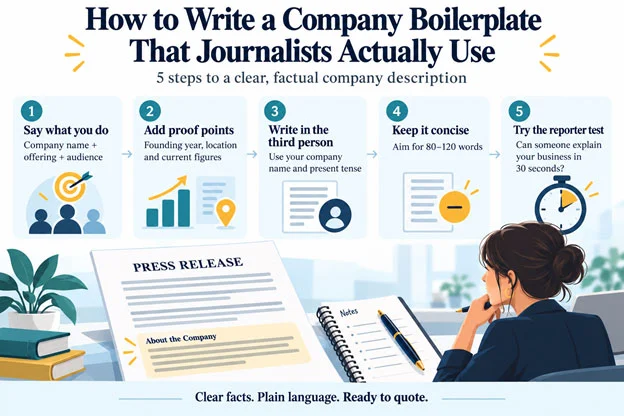
How to Write a Company Boilerplate in 5 Steps
These boilerplate writing tips work whether you’re starting from scratch or fixing one you’ve had for years.
Step 1: Start with one sentence about what you do
Write a single line with three things in it: your name, what you offer and who it’s for. If you can’t fit that into one sentence, don’t move on yet. Everything else in the boilerplate depends on this line being clear.
Step 2: Add your proof points
Next, add the facts a reporter would otherwise have to look up. That means when you were founded, where you’re based and one or two numbers that show your size. Whatever you choose, make sure it’s current and that you could back it up if someone asked.
Step 3: Use the third person and present tense
Say “the company” or use your name, never “we” or “our”. Keep verbs in the present tense, so “provides” rather than “has been providing”.
There’s a practical reason for this. It matches the way news copy is written, so a journalist can drop your text into an article without rewording it.
Step 4: Cut it down to 80 to 120 words
Now go through it with a red pen. Adjectives, product lists, mission statements and anything a reporter wouldn’t quote can all go. For a standard press release boilerplate template, 80 to 120 words is about right. It fits in one paragraph, and it’s quick to scan.
Step 5: Try the reporter test
Hand your draft to someone who doesn’t know your company. Give them thirty seconds, then ask them to explain what you do in one sentence.
If they can, you’re done. If they hesitate, or repeat one of your buzzwords back to you, go back to Step 1. Before submitting your announcement for press release distribution, check that your boilerplate gives journalists a clear, factual description of your company they can use without extensive editing.
Before and After: Rewriting a Boilerplate
This is the kind of boilerplate editors see all the time. The company is made up, but every problem in it is real.
Before:
Quillon is the world’s leading, most innovative payroll solution! We empower businesses of all sizes to unlock their full potential with our revolutionary platform. Our passionate team is dedicated to delivering best-in-class service. Contact us today at sales@quillon.example to book your free demo!
After:
Quillon Payroll is a cloud payroll and HR platform for small and medium-sized businesses in the UK and Ireland. Founded in 2015 and headquartered in Leeds, the company processes payroll for more than 2,300 employers and about 85,000 employees each month. Quillon’s software calculates tax, pension and statutory leave deductions automatically and submits Real Time Information (RTI) reports to HMRC. The company employs 120 people. For more information, visit www.quillon.example.
So what changed? The superlatives came out, because nobody can verify “world’s leading” or “revolutionary”. “We” and “our” became the third person. The sales email and the demo pitch went too, since they don’t belong in a news document.
In their place went what a reporter actually needs: a founding year, a location, a market, two real numbers and a plain description of what the software does. The result is a media-friendly company description a journalist could paste in without changing a word.
Common Boilerplate Mistakes Editors Reject
- Hype words. “Disruptive”, “game-changing” and “best-in-class” get cut almost every time.
- Writing in the first person. Every “we” means the editor has to rewrite the sentence, and most won’t bother.
- Facts that have gone stale. An old office address or last year’s customer count gets repeated wherever your boilerplate is copied.
- Lists that go on and on. Ten products and fifteen awards bury the one line a reporter came for.
- Jargon nobody outside your industry uses. If a general reader wouldn’t know an acronym, spell it out or drop it.
When Should You Update Your Boilerplate?
Simply put, when one of the facts in it comes to be false. Typically, it’s a rebrand, a funding round, an acquisition or an expansion into new industries or markets, or a new product line that alters the company’s business.
When you do update it, change it everywhere at once: your website, your LinkedIn page and your media kit. A journalist who finds two different versions won’t know which one to trust.
Even when nothing big happens, it’s worth a quick look every six months. Numbers drift, and nobody notices until a journalist quotes an old one.
FAQs: Writing a Boilerplate for a Press Release
How long should a company boilerplate be?
Usually 80 to 120 words. That’s enough for the key facts without turning into a second press release.
Should I mention the CEO or founder?
Only if that person is closely tied to the company’s identity, like a well-known founder. Otherwise, save names for the body of the release.
Should a public company include its stock ticker?
Yes. Put the exchange and ticker symbol right after the company name, for example “(NASDAQ: XXXX)”.
About the Author
Written by Tech Digital Labs, specialists in digital marketing, content strategy, and press release writing. Tech Digital Labs helps businesses across industries build a stronger media presence through data-driven content and communications expertise. Tech Digital Labs (https://techdigitallabs.com/)· Last Updated: October 2026