

Left-Wing Extremism is now as much a lesson in policy as a security story. UPSC asked about it in 2025, and the topic will keep returning.
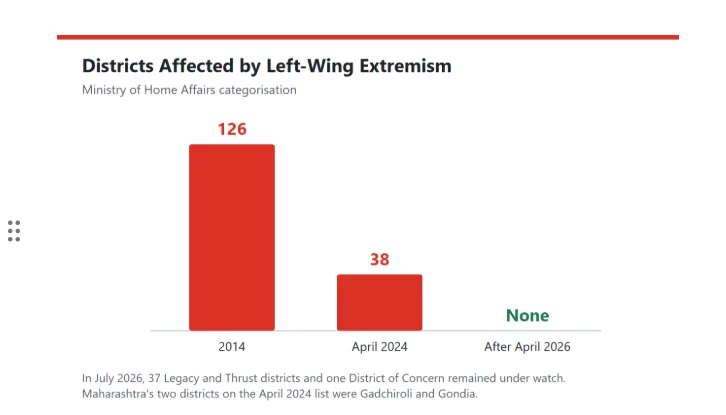
Districts affected by Left-Wing Extremism, from 126 in 2014 to none after April 2026. Data: Ministry of Home Affairs.

Gadchiroli and Gondia were Maharashtra’s two districts on the Union Home Ministry’s April 2024 list of 38 districts affected by Left-Wing Extremism. Two years later, after a reclassification in March and April 2026, no district in the country remained in that category. For aspirants in Vidarbha, the decline of the Naxalite movement unfolded next door, and it is also one of the clearest topics in the internal security part of General Studies Paper III.
UPSC’s Main Examination of 2025 asked what Left-Wing Extremism means, how it affects people and what the government has done to end it. A good answer needs the movement’s origins, the geography of Left-Wing Extremism and the Red Corridor, and measures across security, development and rights. Those three demands run through the whole internal security syllabus, and good internal security notes are organised around them.
From Naxalbari to the CPI (Maoist)
The movement takes its name from Naxalbari in West Bengal’s Darjeeling district, where an armed peasant revolt began in 1967. The first wave was crushed by 1972, but the movement revived in two streams, the People’s War Group in the south and the Maoist Communist Centre in the east. On 21 September 2004 the two merged to form the Communist Party of India (Maoist), which the Union Government banned under the Unlawful Activities (Prevention) Act on 22 June 2009. Violence peaked in 2010, with 1,936 incidents and 1,005 deaths of civilians and security personnel.
Why the Movement Followed the Forests
Mao’s doctrine of protracted people’s war begins in remote hilly or forested land where the state is weak. The movement’s heartland became Dandakaranya, the forested hill country of Chhattisgarh and Odisha that includes Bastar and Abujhmad. Gadchiroli, on Maharashtra’s border with Chhattisgarh and Telangana, lies on the edge of this belt.
Two readings of the causes belong in an answer. The government’s position, stated in Parliament in March 2026, is that ideology rather than poverty was the root cause and that the movement spread where the reach of the state was weak. Scholars such as G. Haragopal trace it to land, forests and the weak working of safeguards such as the Fifth Schedule and the Forest Rights Act. A strong answer presents both.
How the Decline Came
The number of affected districts fell from 126 in 2014 to 38 in April 2024, and to none after April 2026. The Home Ministry’s account names three decisions:
- The National Policy and Action Plan of 2015,which combined security, development and the protection of local rights.
- The SAMADHAN doctrine,announced on 8 May 2017 to guide security operations.
- The physical presence of the state:Fortified police stations rose from 66 before 2014 to 663 by 2026, while 15,189 km of roads and 9,497 mobile towers were built under schemes for the affected areas.
By July 2026, 21,26,268 forest title deeds had been distributed in the erstwhile affected areas.
The Limits an Answer Must Show
The response also had legal limits. On 5 July 2011 the Supreme Court declared state-backed militias such as Salwa Judum illegal and ordered them disbanded. As of July 2026, 37 Legacy and Thrust districts and one District of Concern remain under watch so that the movement cannot return, and the questioning of students and activists over alleged links to banned groups has raised civil-liberties concerns.
The target of a Naxal-free country by 31 March 2026, set on 24 August 2024, has been met in the Home Ministry’s account. For an aspirant, the lesson lies in the method: security opened the way, roads, towers and land titles kept the state present, and the protection of rights is what the examination expects a candidate to weigh alongside both.
About the author
Shikher Goyal is the founder and editorial lead of Digitally Learn, a free study site for the UPSC Civil Services and state PCS examinations. He prepared for the Civil Services Examination from 2012 to 2019, with Geography as his optional subject.