

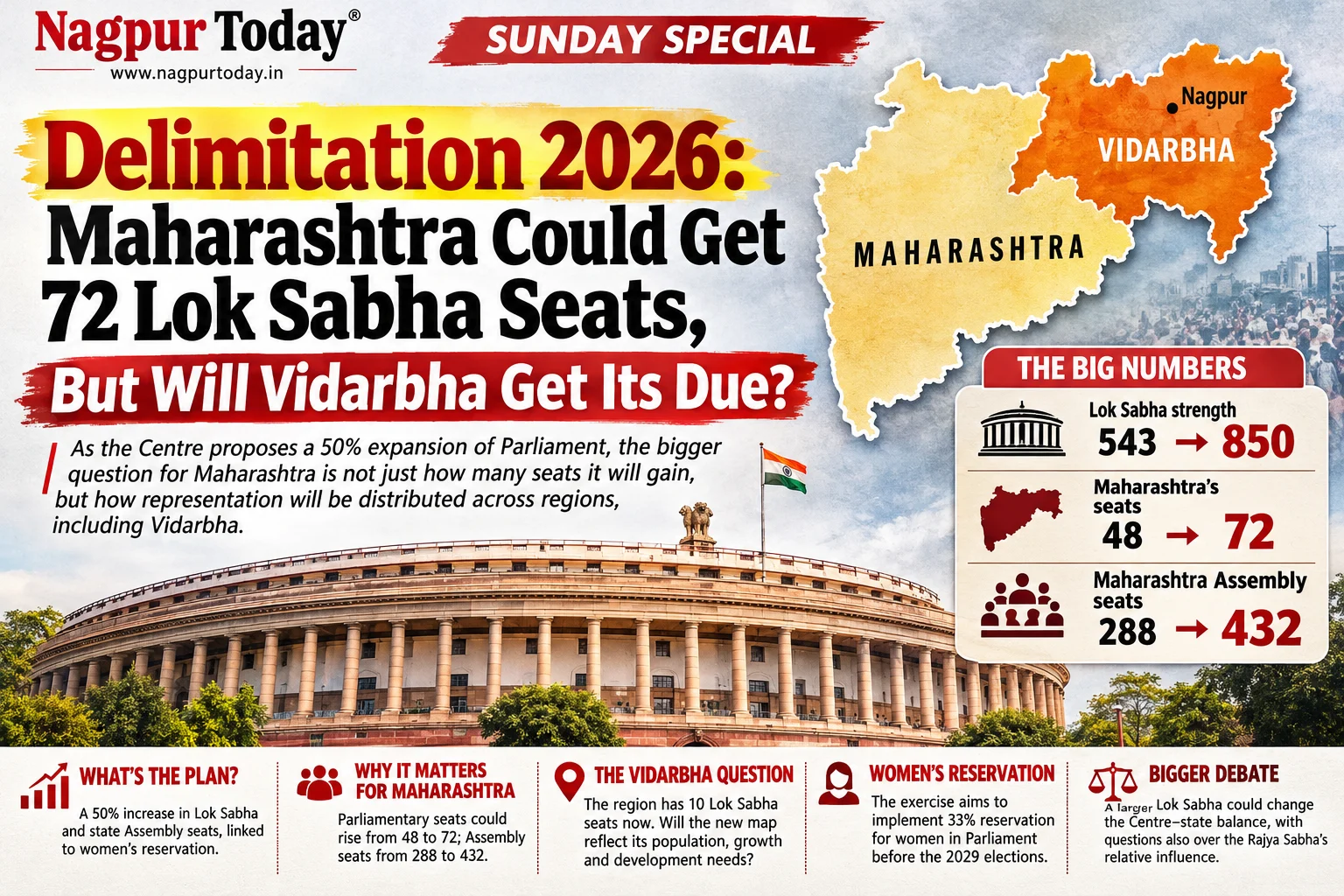
As the Centre proposes a 50% expansion of Parliament, the bigger question for Maharashtra is not just how many seats it will gain, but how representation will be distributed across regions, including Vidarbha.
 NAGPUR: India’s political map could be heading for one of its biggest changes in decades. The Union Cabinet has cleared a fresh constitutional amendment and revised delimitation proposals that could increase the maximum strength of the Lok Sabha from 550 to 850 members, while providing for a 50% increase in parliamentary seats for every state and Union Territory.
The proposal, linked to the implementation of 33% reservation for women in Parliament and state legislative assemblies, is expected to be taken up during the special session of Parliament beginning November 30.
But beyond the national debate over North versus South, the proposed exercise raises an equally important question for Maharashtra: Will the expansion of Parliament translate into better political representation for Vidarbha, particularly Nagpur and its surrounding districts?
Maharashtra’s Lok Sabha strength could rise from 48 to 72
Maharashtra currently sends 48 members to the Lok Sabha. Under the proposed uniform 50% increase, its parliamentary representation could rise to 72 seats.

The proposal also provides for increasing the strength of state legislative assemblies by 50%, subject to the revised constitutional limits.
For Maharashtra, which currently has 288 Assembly constituencies, this could mean an increase to 432 seats.
However, the increase in the total number of seats does not automatically mean that every region within Maharashtra will receive a proportionate increase in political influence.
That is where the delimitation exercise becomes particularly significant.
The Vidarbha question: More seats, but where?
Vidarbha has 10 Lok Sabha constituencies spread across its 11 districts. These include Nagpur, Ramtek, Bhandara-Gondia, Gadchiroli-Chimur, Chandrapur, Wardha, Amravati, Akola, Yavatmal-Washim and Buldhana.
With Maharashtra’s parliamentary strength potentially increasing from 48 to 72, the region’s representation could also be affected by the exercise.
But there is no confirmed constituency-wise allocation yet.
The crucial question is whether the redrawing of constituency boundaries will adequately account for population distribution, urban expansion and demographic changes within the state.
Nagpur, for instance, has witnessed substantial urban expansion, while several parts of Vidarbha continue to face challenges involving infrastructure, agriculture, employment, irrigation and connectivity.
Will these changing realities find adequate representation in the new electoral map?
Or will the exercise primarily redraw existing boundaries without addressing the larger question of regional political balance?
These are questions that deserve attention before the new constituencies are finalised.
Why are Southern states worried about delimitation?
The delimitation debate has largely centred on the difference in population growth between northern and southern India.
States such as Tamil Nadu, Kerala, Karnataka, Telangana and Andhra Pradesh have raised concerns that a purely population-based redistribution could increase the parliamentary strength of states with faster population growth, while reducing the relative influence of states that have successfully controlled population growth.
To address these concerns, the revised proposal introduces a uniform 50% increase in seats for every state and Union Territory.
It also proposes retaining the existing relative share of parliamentary representation among states until the relevant figures of the first Census conducted after 2051 are published.
In effect, states would receive more MPs, but their relative share of the expanded Lok Sabha would remain protected under the proposed formula.
2011 Census: The other major concern
While the overall allocation of parliamentary seats among states would be protected, the proposed delimitation exercise would use the latest published Census figures available when the legislation comes into force to redraw constituency boundaries.
If no newer Census figures have been published by then, the 2011 Census would be the basis.
This distinction is important.
The allocation of seats between states and the distribution of constituencies within a state are two different exercises.
For Maharashtra, this means its overall Lok Sabha share could remain protected even as constituency boundaries within the state are redrawn.
The implications for rapidly expanding urban centres, including Nagpur, will depend on the actual delimitation exercise and the population data used.
A key question is whether population figures from 2011 can adequately reflect the demographic and urban changes that have taken place over the subsequent years.
Women’s reservation and the 2029 target
The proposed delimitation exercise is also closely linked to the implementation of 33% reservation for women in the Lok Sabha and state legislative assemblies.
Although Parliament passed the Women’s Reservation Act in 2023, its implementation was linked to the completion of a Census and a subsequent delimitation exercise.
The Centre’s latest proposals seek to accelerate this process, with the stated objective of operationalising women’s reservation before the 2029 Lok Sabha elections.
The expanded Lok Sabha and state assemblies would provide the framework for implementing the reservation.
What happens to the Rajya Sabha?
Another important dimension concerns the balance between the two Houses of Parliament.
The proposed expansion increases the Lok Sabha’s strength but does not provide for a corresponding expansion of the Rajya Sabha.
This could change the relative weight of the two Houses in joint sittings of Parliament and raises broader questions about the federal character of India’s parliamentary system.
The composition and independence of the proposed Delimitation Commission, which will redraw constituency boundaries, will also be important areas of scrutiny.
The bigger question: Will Vidarbha’s political voice grow?
For Vidarbha, delimitation should not become merely a discussion about increasing the number of MPs.
The region’s long-standing concerns include irrigation, agricultural distress, industrial investment, employment opportunities, infrastructure, healthcare and connectivity.
A larger Parliament may improve the overall representation of citizens, but the actual political impact will depend on how constituencies are structured and how representation is distributed.
Nagpur’s growing urban population, the changing character of surrounding districts and the representation of rural and tribal areas will all be relevant considerations.
There is also a larger political question: Will the new delimitation exercise give regions such as Vidarbha a stronger voice in Maharashtra’s legislative and parliamentary decision-making, or will the existing regional imbalance continue despite an increase in the total number of elected representatives?
The expansion of Parliament could change India’s electoral arithmetic for decades. But for Vidarbha, the real test will be whether the new electoral map reflects the region’s changing population, aspirations and development needs.
For now, the proposals have received Cabinet approval and are yet to become law. The actual impact on Nagpur and Vidarbha will become clearer only after the legislation is considered and the Delimitation Commission publishes its constituency proposals.