

As India observes Constitution Day on November 26, Nagpur holds a special place in the country’s journey towards social justice and equality. It was here that Dr Babasaheb Ambedkar led a historic mass conversion to Buddhism in 1956, creating a landmark in India’s social history.
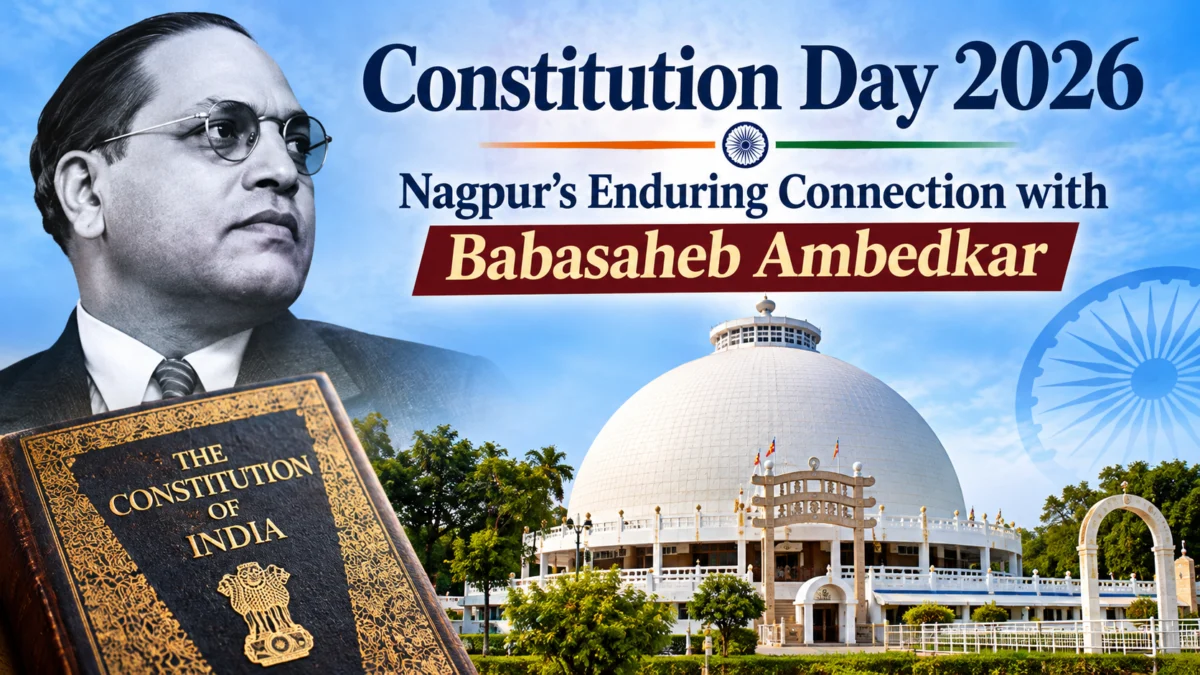 NAGPUR: Every November 26, India remembers the adoption of its Constitution and the ideals of justice, liberty, equality and fraternity on which the Republic stands. While the Constitution was adopted by the Constituent Assembly on November 26, 1949, the occasion carries particular significance for Nagpur, a city deeply connected with the life, philosophy and social movement of Dr Babasaheb Ambedkar.
Nagpur’s connection with the Constitution is not that the document was drafted or adopted here. Rather, it lies in the city’s extraordinary place in Ambedkar’s larger struggle for human dignity, equality and social transformation.
At the centre of this legacy stands Deekshabhoomi.
Deekshabhoomi: Where Nagpur Became a Landmark in India’s Social History
On October 14, 1956, Dr B.R. Ambedkar embraced Buddhism at Nagpur’s Deekshabhoomi along with hundreds of thousands of followers.

The historic ceremony, held on Ashoka Vijayadashami, marked one of the most significant moments in India’s modern social history. Ambedkar, accompanied by his wife Dr Savita Ambedkar, accepted the Three Jewels and Five Precepts from Buddhist monk Mahasthavir Chandramani.
He subsequently administered the 22 vows to his followers, marking the beginning of a powerful movement of social and religious transformation.
The Government of Maharashtra’s Nagpur district administration records the participation of approximately 380,000 followers in this historic conversion. Other historical accounts place the gathering at around five to six lakh.
For Ambedkar, the decision to embrace Buddhism was deeply connected with his lifelong struggle against caste discrimination and the denial of equality and dignity.
Deekshabhoomi consequently became much more than a religious site. It emerged as a symbol of self-respect, emancipation, equality and the assertion of human rights.
Ambedkar and the Making of the Indian Constitution
Dr Babasaheb Ambedkar’s contribution to the Indian Constitution remains central to India’s democratic history.
As Chairman of the Constitution’s Drafting Committee, constituted on August 29, 1947, he played a defining role in shaping the document that established the framework of independent India’s democratic governance.
The Constitution was the outcome of extensive deliberations by the Constituent Assembly, comprising representatives from different backgrounds and regions. Ambedkar’s leadership and legal scholarship were instrumental in shaping its final framework.
The Constitution was adopted on November 26, 1949, and came into force on January 26, 1950.
Its commitment to equality before the law, fundamental rights, protection against discrimination and social justice reflected many of the principles that Ambedkar had championed throughout his public life.
Why November 26 Matters
Constitution Day, also known as Samvidhan Diwas, commemorates the adoption of the Indian Constitution on November 26, 1949.
The day was formally designated as Constitution Day in 2015, marking the 125th birth anniversary year of Dr Babasaheb Ambedkar.
The observance aims to promote awareness of constitutional values and encourage citizens to understand their rights, duties and responsibilities.
The Preamble begins with the words ‘We, the People of India’, placing the people at the centre of the country’s constitutional framework.
It promises justice, liberty, equality and fraternity — ideals that remain particularly relevant in a society continuing to confront questions of discrimination, social inequality and access to opportunity.
Nagpur’s Continuing Constitutional Legacy
Nagpur’s relationship with Ambedkar’s legacy continues through Deekshabhoomi, which attracts visitors and followers from across India and abroad.
Every year, particularly on Dhammachakra Pravartan Day, lakhs of people gather at the historic site to commemorate the 1956 conversion and reaffirm their commitment to the values of equality and social dignity.
The city also carries a wider historical significance as a centre of the Ambedkarite movement and the spread of Navayana Buddhism.
For Nagpur, Deekshabhoomi is not merely a monument. It represents a historic decision that challenged entrenched social hierarchies and gave a new direction to the aspirations of millions.
Beyond Celebrations: The Constitution as a Living Commitment
As India marks Constitution Day 2026, the occasion is an opportunity to look beyond ceremonial readings of the Preamble and reflect on how constitutional values are practised in everyday life.
Equality is meaningful only when discrimination is challenged. Liberty matters when every individual can exercise their freedoms. Justice becomes real when institutions protect the rights of all citizens, irrespective of their background.
For Nagpur, this reflection carries an additional responsibility.
The city that witnessed Ambedkar’s historic social revolution also carries the responsibility of preserving and promoting the ideals associated with his life and work.
Nearly seven decades after the historic event at Deekshabhoomi, its message remains relevant: democracy is strengthened not merely by institutions and laws, but by the dignity, equality and participation of every citizen.
This Constitution Day, Nagpur’s greatest tribute to Babasaheb Ambedkar may be to keep the ideals he fought for alive in everyday public life.