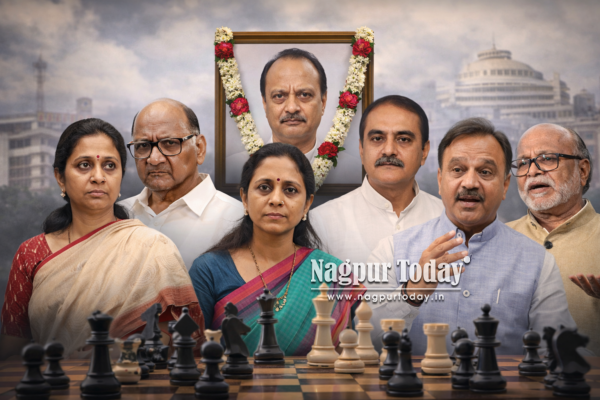
Mumbai: The sudden death of Maharashtra Deputy Chief Minister Ajit Pawar in a plane crash in Baramati has triggered a political earthquake in the State, throwing the Nationalist Congress Party (NCP) and its Sharad Pawar-led faction into deep uncertainty at a moment when both were inching towards reconciliation and a possible merger.
Ajit Pawar’s demise has created a triple vacuum, in government, in party leadership, and within the powerful Pawar family’s carefully balanced political arrangement. Questions now dominate Maharashtra’s political discourse: Who will take over as NCP President? Who will replace Ajit Pawar as Deputy Chief Minister? And who will steer the sensitive merger talks between the NCP and NCP (Sharad Pawar)?
Gold Rate
Mar 25,2026 - Time 11.05Hrs

As per protocol, Ajit Pawar’s key portfolios, Finance, Planning, Excise and Youth Affairs, have temporarily gone to Chief Minister Devendra Fadnavis. The NCP Legislature Party is expected to meet shortly to finalise its nominee for Deputy CM and formally communicate its decision to the BJP leadership within the Mahayuti-NDA alliance. The choices the party makes now could redefine Maharashtra politics for years.
Merger moment turns fragile
The timing of Ajit Pawar’s death could not have been more politically consequential. Just months ago, the uncle-nephew duo, Sharad Pawar and Ajit Pawar, had publicly reconciled, declaring family unity and signalling a gradual reunification of the fractured party. Pilot projects, including joint participation in Pune civic elections and plans to contest zilla parishad polls under the iconic ‘clock’ symbol, were already underway.
That momentum has now stalled. The merger question has become more complex as the two factions currently sit on opposite sides of Maharashtra’s political divide, Ajit Pawar’s NCP in the BJP-led Mahayuti-NDA, and Sharad Pawar’s NCP (SP) in the Congress-led Maha Vikas Aghadi and INDIA bloc.
Pawar family at the centre
All roads now lead to Sharad Pawar, the 85-year-old patriarch, whose word carries unmatched moral and political weight across factions. Deeply shaken by the loss of his protégé and nephew, Sharad Pawar is expected to play the decisive role in succession planning, party unification and future alignments.
Within the family, attention has turned to Sunetra Pawar, Ajit Pawar’s wife and a Rajya Sabha MP. Though she lost the high-profile Baramati Lok Sabha battle to Supriya Sule, Sunetra Tai remains a respected organisational figure and a potential consensus face, especially if the party opts for continuity over confrontation.
Ajit Pawar’s sons, Parth Pawar and Jay Pawar, also enter the frame. While Parth has been slowly inducted into higher-level party deliberations amid controversies, Jay has so far stayed away from active politics. Whether either will be groomed for a formal political role remains an open question.
Power brokers and political balancers
Among senior leaders, Praful Patel, the NCP Working President and Sharad Pawar’s trusted lieutenant, is widely seen as the key strategist who could hold the party together during the transition. With deep experience in organisational battles and legal-political manoeuvring, Patel is expected to be central to merger talks and negotiations with allies.
Sunil Tatkare, Maharashtra NCP President and a close Ajit Pawar aide, is another crucial figure, especially in managing cadre morale and maintaining the party’s presence within the Mahayuti government. Veteran OBC leader Chhagan Bhujbal, a mass leader with deep grassroots appeal, remains influential in balancing caste equations and ensuring political stability.
On the NCP (SP) side, Supriya Sule continues to be the national face and a strong parliamentary performer, while Jayant Patil, an experienced administrator and financial expert, remains a vital bridge-builder respected across party lines.
A turning point for Maharashtra politics
Ajit Pawar’s death has not just removed a power centre—it has disrupted a carefully calibrated political ecosystem in Maharashtra. The decisions taken in the coming weeks, on leadership, alliance equations and the long-discussed merger, will determine whether the NCP emerges united and stronger, or slips into prolonged uncertainty.
For now, Maharashtra watches closely as the Pawar family and senior NCP leaders attempt to navigate grief, ambition and realpolitik, aware that one wrong move could permanently alter the state’s political landscape.