
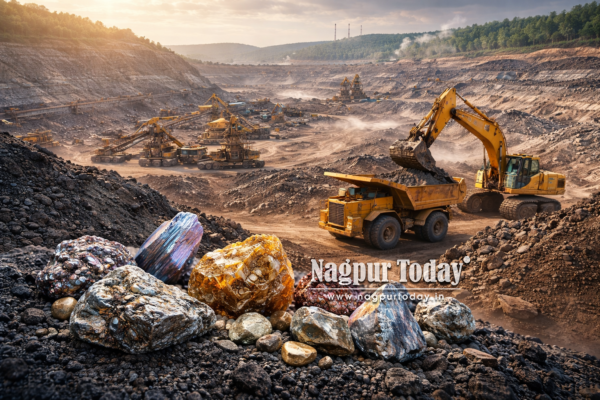
Nagpur: In a development that could redefine its future beyond coal, Nagpur-based Western Coalfields Limited (WCL) has achieved a landmark breakthrough by discovering significant deposits of rare earth elements (REEs) and critical strategic minerals across six of its mines in Maharashtra.
Featured Products
The public sector mining giant confirmed the presence of eight high-value minerals, a find that could potentially transform mine overburden and rejects into a strategic national resource.
Gold Rate
Apr 15 2026 - Time 10.30Hrs

Discovery across six mines
The breakthrough emerged from elemental analysis conducted at six WCL projects: Adasa (UG to OC), Makardhokda-III, Durgapur OC, Gauri-Pauni, Mungoli-Nirguda, and Yekona I & II.
Scientific assessment revealed economically significant concentrations of:
• Potash (K)
• Tellurium (Te)
• Titanium (Ti)
• Lanthanum (La)
• Cerium (Ce)
• Rhenium (Re)
• Selenium (Se)
• Zirconium (Zr)
These minerals are considered critical to next-generation industries ranging from electric vehicles and renewable energy to aerospace, defence, nuclear technology and semiconductors.
From waste to wealth
What makes the discovery particularly remarkable is its source. The minerals were identified not in new excavation zones but within overburden and mine rejects, material traditionally treated as waste during coal extraction.
This shifts the economic narrative dramatically: Discarded material could now evolve into a high-value strategic asset.
A senior official stated that the findings open “multiple diversification pathways” for WCL, offering a commercial mineral resource stream that strengthens mine economics and long-term sustainability.
Strategic significance
Rare Earth Elements such as Lanthanum and Cerium are indispensable for EV motors, permanent magnets, catalysts and advanced electronics. Tellurium plays a key role in solar photovoltaic cells and semiconductors, while Titanium is vital for aerospace and defence alloys. Rhenium is used in jet engines and superalloys. Zirconium supports nuclear and refractory industries.
In an era where global supply chains of critical minerals are geopolitically sensitive, such a discovery positions WCL as a potential strategic contributor to India’s mineral security.
National-level collaboration
The analysis was conducted through accredited agencies, with reports submitted to the Non-Ferrous Materials Technology Development Centre (NFTDC), Hyderabad, for advanced technical evaluation.
A Memorandum of Understanding has already been executed between Coal India Limited (CIL) and NFTDC to develop applied R&D projects, pilot extraction plants, and demonstration-scale commercial technologies.
With this institutional backing, WCL is now poised to:
• Conduct detailed resource estimation
• Undertake techno-economic feasibility studies
• Develop extraction and beneficiation processes
• Establish pilot and commercial-scale plants
• Forge partnerships with PSUs, private industries and technology providers
As global coal demand gradually moderates in the long term, rare earth and critical minerals present WCL with a future-ready alternative revenue stream. By leveraging its existing mining infrastructure and national policy support, WCL could transition from a conventional coal producer into a diversified strategic mineral powerhouse.
Industry observers say this discovery may not merely enhance profitability — it could reposition WCL at the heart of India’s emerging critical mineral ecosystem.
If successfully commercialised, the breakthrough may mark the beginning of a structural transformation: from coalfields to critical mineral frontiers.