

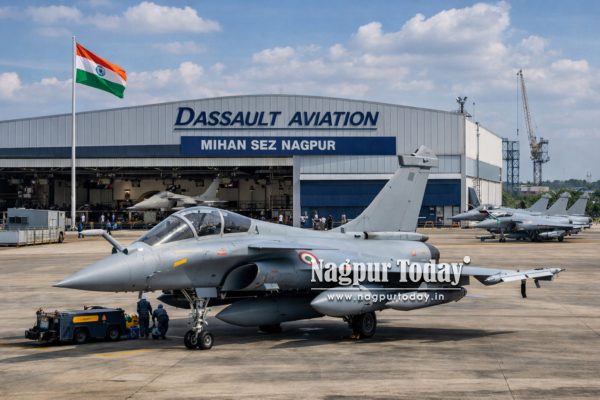
Nagpur: In a landmark decision set to transform India’s defence manufacturing landscape, the Defence Acquisition Council (DAC) chaired by Defence Minister Rajnath Singh on Thursday has cleared the procurement of 114 Rafale fighter jets, with Nagpur poised to play a central role in their production.
Featured Products
For Nagpur, the development marks a moment of immense strategic and industrial significance. A majority of these advanced fighter aircraft are expected to be manufactured at the Dassault Aviation facility located in the MIHAN Special Economic Zone (SEZ), positioning the city as a major node in India’s ‘Make in India’ defence push.
Gold Rate
Apr 15 2026 - Time 10.30Hrs

From France to Nagpur: A historic shift
Until now, Rafale fighter jets were primarily manufactured in France, with only select components being produced in India. However, under the newly approved framework, the MIHAN plant will undertake comprehensive manufacturing, from airframe construction to final assembly.
Sources indicate that of the proposed 114 jets, 18 are likely to be delivered in fly-away condition, while 96 will be manufactured in India, largely at the Nagpur facility. The plant is being designed with an annual production capacity of up to 24 aircraft.
Up to 60% indigenous content
Officials say that Rafale jets built in Nagpur will incorporate up to 60% indigenous content. Key components to be manufactured locally include:
• Airframes
• Titanium fuselage structures
• Delta wings
• Advanced avionics
• AESA radar systems
• SPECTRA electronic warfare systems
Missile systems and sensors will then be integrated to complete the final combat-ready aircraft.
The move significantly enhances domestic defence capabilities while reducing long-term dependency on imports.
The Nagpur facility is expected to manufacture the latest Rafale variants for the Indian Air Force, including the F4 and next-generation F5 models.
The F4 variant will feature improved network-centric warfare capabilities and upgraded radar systems. The F5, often referred to as the “Super Rafale,” is expected to incorporate stealth drone control capabilities, more powerful engines and enhanced long-range missile systems.
Three-year timeline for ‘Made in India’ Rafale
Industry sources estimate that the first fully ‘Make in India’ Rafale from the MIHAN facility could roll out within three years. This period will involve workforce training, supply chain development, infrastructure scaling and certification processes.
The project is part of a proposed Rs 3.25 lakh crore defence deal and is expected to generate thousands of high-skilled jobs in Nagpur and the wider Vidarbha region. Local MSMEs, engineering firms and startups are likely to become part of the supply chain, with major Indian conglomerates such as Tata and Mahindra expected to collaborate in component manufacturing.
Strategic boost for Nagpur
With this development, Nagpur is set to evolve into a global aerospace manufacturing hub for Rafale jets. The city’s MIHAN SEZ, once envisioned as a logistics and industrial growth centre, now stands at the threshold of becoming a strategic defence manufacturing powerhouse.
If executed as planned, the Rafale project will not only strengthen India’s air combat capability but also firmly place Nagpur on the global defence industry map.