

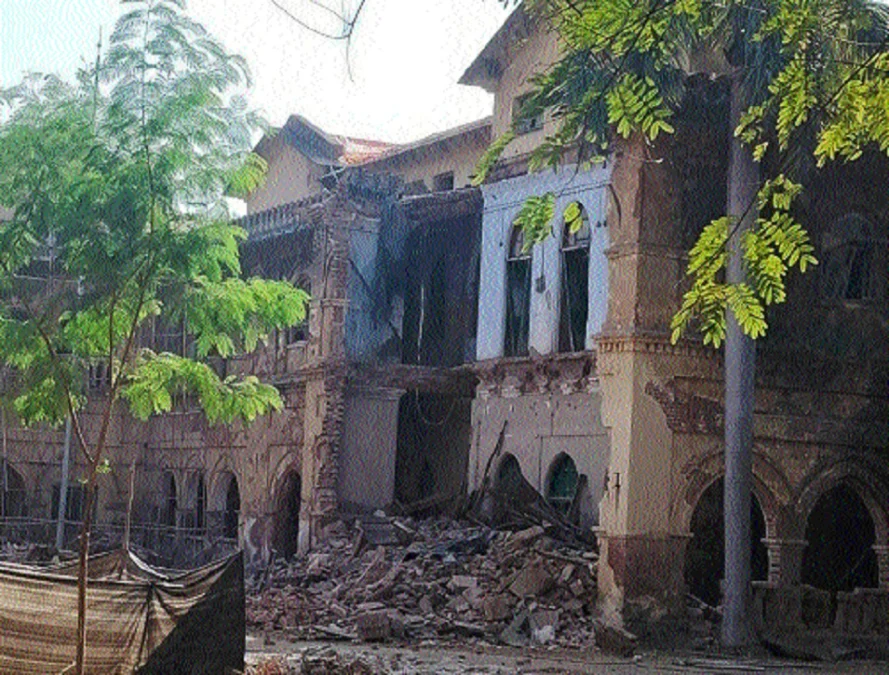
Nagpur: A portion of Nagpur’s historic Old High Court building in Civil Lines came crashing down on Monday afternoon, exposing the alarming state of neglect surrounding the conservation of the heritage structure and raising serious questions over the effectiveness of official inspections and restoration measures. The collapse occurred despite repeated inspections by the Archaeological Survey of India (ASI) and specific warnings issued to the Public Works Department (PWD) about alleged deviations from approved conservation standards.
A potentially serious tragedy was narrowly averted as workers engaged at the site escaped unhurt. They were away from the spot having lunch when the rear portion of the ageing structure collapsed. Had four to five workers been present, they could have been trapped or buried under the falling debris.
The incident has brought renewed urgency to the issue of the building’s deteriorating condition, which is already under the scrutiny of the Bombay High Court’s Nagpur Bench through a suo motu Public Interest Litigation (PIL). The High Court had taken cognisance of the building’s condition, and the next hearing is scheduled after Diwali.
ASI flags conservation violations, but structure collapses

What makes the collapse particularly disturbing is that the ASI had reportedly inspected the premises several times during October. On October 23, the central conservation agency even wrote to the PWD Chief Engineer in Nagpur, explicitly pointing out that the conservation work was not being executed in accordance with the approved estimates and the National Conservation Policy, 2014.
The warning was followed by another visit by an ASI official on October 27, during which discussions were held with PWD officials regarding the conservation work.
Despite these inspections and the written communication highlighting shortcomings, the rear portion of the historic building gave way on Monday. The collapse raises uncomfortable questions about whether the concerns flagged by the ASI were adequately addressed, whether corrective measures were undertaken in time and whether the structure was being monitored with the seriousness its fragile condition demanded.
The sequence of events also puts the spotlight on coordination between the ASI and PWD, particularly after responsibility for the building was transferred from the former to the latter.
Responsibility transferred, accountability remains
The historic building was handed over by the ASI to the PWD on September 30, 2026. The transfer placed the responsibility for the ongoing conservation work with the state agency.
However, the subsequent ASI correspondence dated October 23 indicates that concerns over the manner in which the work was being executed had already surfaced within weeks of the handover.
The collapse has therefore raised questions about the monitoring mechanism, adherence to conservation specifications and the response to technical objections raised by the heritage agency. The crucial issue is whether the structural risks were properly assessed and whether the necessary safeguards were put in place before workers were allowed to operate at the site.
High Court monitoring adds urgency
The deteriorating condition of the Old High Court building is already the subject of judicial scrutiny. The High Court initiated a suo motu PIL to examine the condition and conservation of the historic structure.
Advocate Ashutosh Dharmadhikari is assisting the court as amicus curiae, while Advocate Deepak Thakre is representing the government in the matter.
The collapse, occurring while the issue is pending before the court, adds another serious dimension to the proceedings. The incident is likely to bring the actual progress of conservation work, the ASI’s objections and the PWD’s response into sharper focus during the next hearing.
Future use of building also raises questions
The PWD had earlier informed the High Court that the ASI’s sub-circle office and storeroom would be shifted to the remaining portion of the building after completion of the conservation work.
However, the collapse of a section of the structure has raised fresh concerns about the safety and suitability of the surviving portions, as well as the feasibility of the proposed arrangement.
The immediate priority now is to assess the structural stability of the entire building, examine the reasons behind the collapse and establish whether the earlier warnings were adequately acted upon.
For a historic structure already under judicial scrutiny, another portion falling into ruins is more than a construction mishap. It is a serious warning about the consequences of delayed intervention, inadequate conservation and possible failures in institutional coordination.
The Old High Court building has now suffered a physical collapse, but the bigger question confronting the authorities is whether the warnings that preceded it were allowed to fall on deaf ears.