
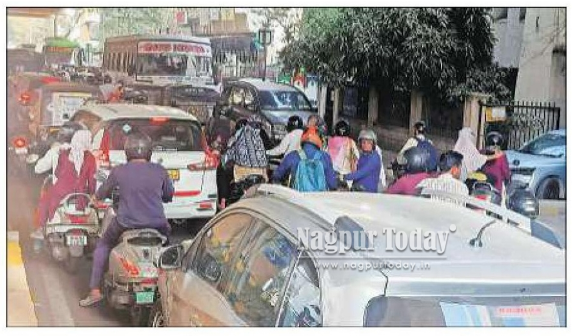
Nagpur: In what can only be described as a textbook case of administrative apathy and poor planning, traffic near Ajni Railway Station spiralled into complete disorder on Thursday after authorities abruptly shut vehicular movement from Rani Ahilyabai Holkar Square towards Congress Nagar Square, without warning, preparation, or proper traffic management.
The sudden closure turned a routine weekday into hours of gridlock, confusion and public outrage.
Gold Rate
Apr 06,2026 - Time 10.30Hrs

Chaos by design?
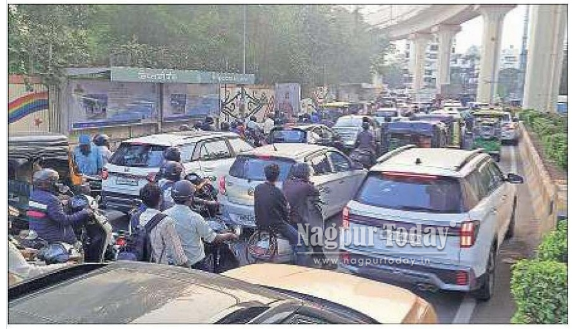
With no prior public notice or adequate signboards, motorists were caught off guard as traffic was forcibly pushed in the opposite direction. The immediate fallout was severe congestion along the stretch near Shivaji Science College, with vehicles crawling bumper-to-bumper under the afternoon sun.
As authorities tightened restrictions and banned entry towards Congress Nagar Square entirely, traffic was diverted towards Kriplani Square and Medical Square, a move that only shifted the crisis rather than solving it. By evening peak hours, vehicle queues at Kriplani Square reportedly stretched up to 1 to 1.5 kilometres.
Commuters were forced to take long, fuel-draining detours, losing precious hours in the process.
Railway passengers left stranded
The worst-hit were railway passengers arriving at Ajni Railway Station. With access roads abruptly blocked, many were compelled to get down at Rani Ahilyabai Holkar Square and walk through chaotic traffic to reach the station. Elderly passengers, women with children, and those carrying luggage faced immense hardship.
All this because of an underpass project being executed by the State Public Works Department (PWD), connecting Ajni Railway Station to FCI Road beneath Rani Ahilyabai Holkar Square, a project that, ironically, aims to improve connectivity but has instead exposed glaring coordination failures.
No notice, no planning, no accountability
What aggravated public anger was the complete absence of advance intimation. There were no warning boards, no pre-announced diversion plans, and no visible public advisory before implementing such a major traffic shift.
The consequences were alarming. An ambulance was reportedly trapped in the congestion near Ajni Railway Station, unable to move as vehicles had no space to give way, a dangerous reminder that such mismanagement can cost lives.
Traffic from Medical Square and FCI Road heading towards Congress Nagar was forced to proceed till Kriplani Square and take a detour via Rahate Colony T-point. Meanwhile, barricaded medians further worsened the situation by choking available road space.
Signal mismanagement adds fuel to fire
If the road closure triggered the crisis, poor signal coordination deepened it. At Kriplani Square, traffic signals reportedly allowed vehicles from Rani Ahilyabai Holkar Square barely 15 seconds to cross, while other directions enjoyed green lights for 30 to 45 seconds.
The imbalance forced motorists to endure six to eight signal cycles just to cross a single junction, a glaring sign of lack of coordination between agencies.
Traffic police missing in action
Despite congestion spreading up to Lokmat Square, Ajni Square and surrounding roads, traffic personnel were largely absent from critical intersections such as Kriplani Square, Rahate Colony T-point, Congress Nagar Square and Ajni Square.
Officials were seen stationed only at Rani Ahilyabai Holkar Square, leaving other pressure points unmanaged as chaos unfolded across the network.
Citizens demand answers
The episode has raised uncomfortable questions:
Why was such a major diversion executed without public notice?
Why was there no coordinated traffic management plan?
Why were emergency routes not safeguarded?
Infrastructure projects are meant to ease public life, not paralyse it. Thursday’s traffic disaster near Ajni Railway Station stands as a stark example of how poor execution and lack of accountability can turn development work into a civic nightmare.
For Nagpur’s commuters, the message was loud and clear: When authorities fail to plan, citizens suffer.