

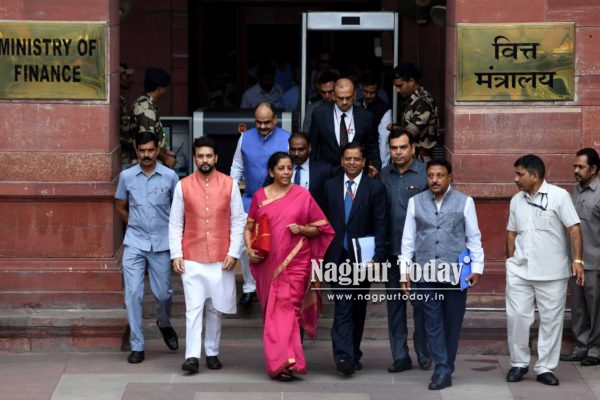
 New Delhi: Finance Minister Nirmala Sitharaman on Saturday presented a growth-focused Union Budget, doubling down on infrastructure spending, easing compliance for taxpayers and businesses, and rolling out a sweeping package for healthcare, agriculture, manufacturing, and technology.
At the core of the Budget is a strong capital expenditure thrust, with government capex pegged at ₹12.2 lakh crore for FY2026–27, signalling continued investment-led growth even as the Centre commits to gradually lowering its deficit. The fiscal deficit is estimated at 4.3% of GDP for 2026–27, while the debt-to-GDP ratio is projected at 55.6%, slightly improving from last year.
Big Relief for Taxpayers
The Budget brings meaningful changes to income tax compliance:
Gold Rate
Apr 06,2026 - Time 10.30Hrs

Individuals filing ITR-1 and ITR-2 can now submit returns till July 31, while non-audit business cases and trusts get time till August 31. Taxpayers will also be allowed to update returns even after reassessment proceedings, subject to a nominal fee.
The government announced plans to rationalise the prosecution framework under the Income Tax Act and clarified that TDS on sale of immovable property by NRIs will now be deducted by the resident buyer. Dividend income between cooperative societies becomes deductible under the new tax regime, and IT services safe harbour limits jump sharply to ₹2,000 crore, with services unified under a single 15.5% margin.
Another notable change: tax on share buybacks will now be treated as capital gains for all shareholders, aligning treatment across investor categories.
Massive Boost for Data Centres, MSMEs and Banking
In a clear signal to global tech players, the government announced a tax holiday till 2047 for foreign firms providing cloud services by setting up data centres in India—a long runway designed to anchor hyperscale infrastructure locally.
To support small businesses, “Corporate Mitras” will be introduced to help MSMEs navigate regulatory compliance, alongside a ₹10,000 crore allocation to accelerate SME growth.
In the power and finance space, Power Finance Corporation and REC are set to be restructured. A high-level committee on banking for “Viksit Bharat” will also be constituted, while the Self-Reliant India Fund receives a ₹2,000 crore top-up.
Healthcare: Biopharma, Cheaper Cancer Drugs, Medical Hubs
Healthcare emerges as a standout winner. The Budget earmarks ₹10,000 crore over five years for “Biopharma Shakti,” along with plans to build a network of 1,000 accredited clinical trial sites. The government also announced medical hubs for AYUSH centres, expanded diagnostics infrastructure, and post-care rehabilitation facilities.
Importantly for patients, the Budget promises lower costs for select cancer drugs, aiming to widen access to advanced treatment.
Farmers, Rural India and Social Welfare
The Centre reaffirmed its goal of raising farmer incomes through targeted interventions, including:
- Development of 500 reservoirs for irrigation support
- Credit-linked subsidies for animal husbandry
- Dedicated programmes for cashew and cocoa
On the social front, the government highlighted that 25 crore people have exited multidimensional poverty over the past decade. Rural enterprise will be encouraged through the Mahatma Gandhi Gram Samaj initiative (named after Mahatma Gandhi), focusing on Khadi and handicrafts, alongside community-owned Self-Help Entrepreneur (SHE) marts to strengthen women-led businesses.
Railways, Waterways and Core Infrastructure
Seven high-speed rail corridors are planned as growth connectors between major cities, while 20 new national waterways will be developed over the next five years. Infrastructure investments will continue to prioritise Tier-2 and Tier-3 cities, complemented by hi-tech tool rooms for advanced materials and a new East Coast Development Corridor.
Customs duty exemptions on nuclear power project inputs will now apply across all plants, helping accelerate clean energy capacity.
Manufacturing, Semiconductors and Technology
Under the Make in India push, manufacturing will be scaled across seven strategic sectors, backed by:
- ₹40,000 crore for India Semiconductor Mission 2.0
- ₹10,000 crore for container manufacturing
- A scheme to revive 200 legacy industry clusters
A dedicated committee will also study the impact of emerging technologies, including AI, on the services sector.
Markets, Foreign Investment and Tourism
To deepen capital markets, the government will introduce a market-making framework for corporate bonds and conduct a comprehensive review of foreign exchange rules. In a major liberalisation move, foreign investors will now be allowed to buy Indian stocks directly.
Tourism is positioned as a major employment engine, with plans to train 1.5 lakh caregivers, create medical value tourism hubs, and establish a National Institute of Hospitality.
The Bottom Line
This Budget sticks to a clear philosophy: spend big on infrastructure, make compliance easier, court global tech capital, and broaden social investment-while keeping a watchful eye on fiscal discipline. With capex at record levels and long-term bets on data centres, biopharma, semiconductors, and manufacturing, the government is signalling confidence in India’s growth trajectory-tempered by a promise to steadily rein in deficits as the economy scales.